
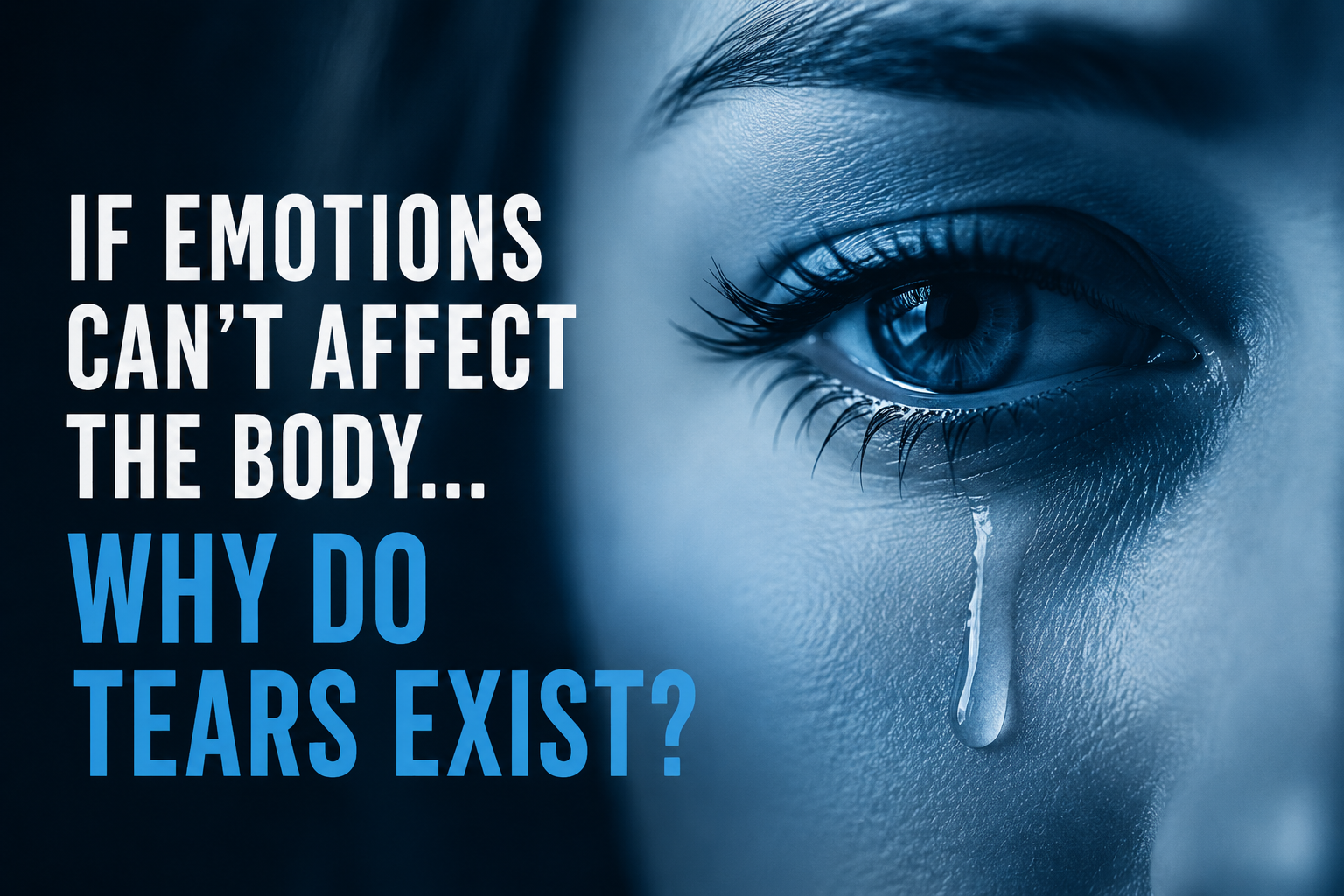
Close-up of a tear falling from a person’s eye, illustrating the physical connection between emotions and the body.
Tears are proof that emotions become physical.
Most people have no problem accepting that emotions affect the body.
Until you suggest they might affect the body for longer than a few minutes.
Then suddenly the idea becomes controversial.
But think about it.
Nobody argues that grief can produce tears.
Nobody argues that fear can make your heart race.
Nobody argues that anxiety can upset your stomach.
Nobody argues that embarrassment can make your face turn red.
These are all emotional experiences creating physical responses.
The question isn't whether emotions affect the body.
They already do.
The real question is:
How long do those effects last?
Your Body Is Already Listening
Imagine you're about to give a speech in front of 500 people.
Before you've said a word:
your heart rate changes
your breathing changes
your muscles tighten
your palms sweat
your stomach feels different
Nothing physical happened to you.
No injury.
No illness.
No external threat.
Just a thought.
An emotional response.
And your body immediately follows.
Most of us have experienced this countless times.
We've simply learned to think of it as normal.
So Where Do We Draw The Line?
This is where things get interesting.
If 30 seconds of embarrassment can make your face turn red...
If a stressful phone call can raise your blood pressure...
If anxiety can cause digestive issues...
Then what happens when the emotional stress isn't temporary?
What happens when:
resentment is replayed for years?
grief never fully resolves?
fear becomes a daily state?
anxiety becomes a lifestyle?
emotional pain is pushed down instead of processed?
Would it make sense for the body to simply ignore that?
Or would it continue responding?
What Science Already Knows
This isn't just an alternative healing conversation.
Modern science has spent decades studying the relationship between emotional stress and physical health.
Chronic stress has been linked to:
increased inflammation
elevated cortisol levels
immune system suppression
digestive issues
sleep disturbances
tension and pain patterns
cardiovascular strain
In other words...
The body does not separate emotional experiences from physical experiences nearly as much as we do.
It responds to both.
Continuously.
Nobody debates whether chronic stress affects the body.
The debate is usually about how much.
The Question Most People Never Ask
When symptoms appear, most people ask:
"What's wrong with my body?"
That's a reasonable question.
But there may be another question worth asking:
"What emotional environment has my body been living in?"
Because your body isn't just responding to what happened yesterday.
It's responding to what has been repeated.
Repeated thoughts.
Repeated reactions.
Repeated emotional states.
Repeated stress.
Repeated meaning.
And over time, repetition becomes biology.
A Different Way To Look At Pain
This doesn't mean every illness is emotional.
It doesn't mean every symptom is caused by trauma.
And it certainly doesn't mean people should avoid proper medical care.
But what if emotions are contributing more than we've been taught to consider?
Over the years, I've worked with people who came in wanting help with physical pain, tension, fatigue, or symptoms that seemed disconnected from anything emotional.
And in many cases, when we began identifying and clearing the subconscious programs and emotional charges underneath the surface, something interesting happened.
The body responded.
Sometimes immediately.
Sometimes gradually.
Sometimes in ways neither of us expected.
Does that prove every symptom is emotional?
No.
But it raises an important question:
What role might unresolved emotional stress be playing that we're overlooking?
What If The Body Isn't Just Malfunctioning?
We often view symptoms as problems.
Something to suppress.
Something to get rid of.
Something standing in the way.
But what if some symptoms are information?
What if they're pointing toward something that hasn't been addressed?
Not punishment.
Not weakness.
Not bad luck.
A message.
An invitation to look deeper.
Because if emotions can create tears...
If emotions can create butterflies...
If emotions can create nausea...
If emotions can create tension...
Then perhaps it's worth considering what years of unresolved emotional stress may be creating as well.
The Bigger Question
If you've been dealing with:
chronic tension
recurring pain
fatigue
stress-related symptoms
physical issues that never seem to fully resolve
It may be worth asking a different question.
Not just:
"What's wrong with me?"
But:
"What has my body been trying to tell me?"
Because sometimes the symptom isn't the whole story.
Sometimes it's the doorway to it.
Ready to Explore What's Underneath?
If you're curious whether emotional stress, subconscious programming, or unresolved experiences may be contributing to what you're experiencing, I offer a $47 Discovery Session where we can explore what's happening beneath the surface.
Because understanding the message is one thing.
Changing what's creating it is another.
