
Autopsy of a Reaction
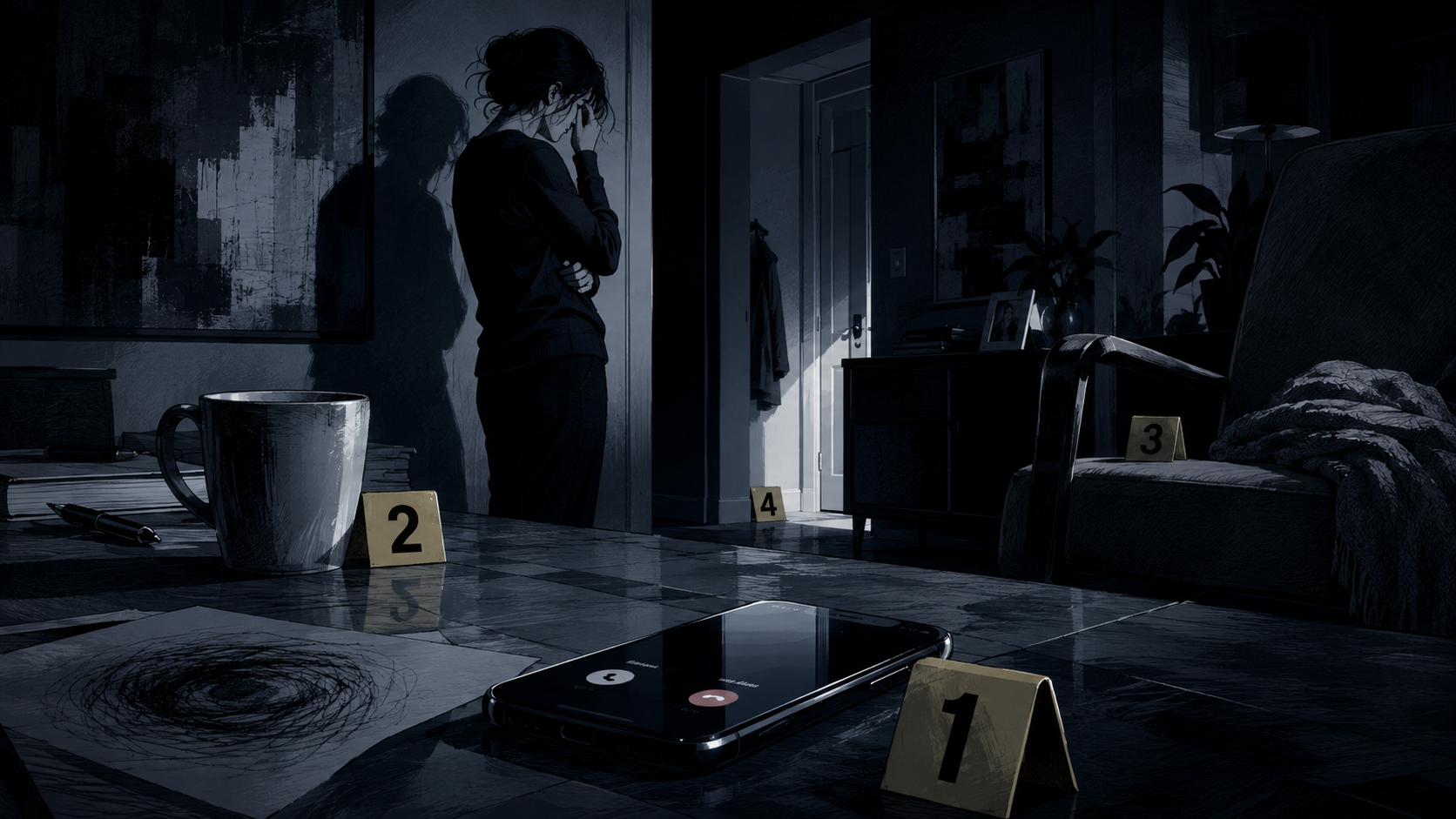
Dark room with numbered evidence markers and a silhouetted person, illustrating the idea of examining an emotional reaction for clues about what triggered it.
The Biology of “I Don’t Know Why I’m Like This”
The scene looks ordinary at first.
A kitchen.
A phone on the counter.
A message left unanswered.
A tone of voice that lands wrong.
A look from someone you love that feels colder than it probably was.
Nothing dramatic has happened.
No one is bleeding.
No one has slammed a door.
No one has said the one thing that would explain what comes next.
But inside the body, something has already been activated.
The chest tightens.
The stomach drops.
The jaw locks.
The nervous system starts gathering evidence.
And then it happens.
A sharp reply.
A sudden shutdown.
A wave of panic.
The urge to leave, defend, disappear, apologize, overexplain, or emotionally collapse.
Five minutes later, the scene is quiet again.
But now there is a different question sitting in the room.
“Why am I like this?”
That is the question most people take at face value.
They assume the reaction is the problem.
They assume their personality is the problem.
They assume they are too sensitive, too reactive, too emotional, too damaged, too much.
But what if the reaction is not the crime?
What if it is the evidence?
What if your body is not randomly overreacting to the moment in front of you?
What if it is responding to something older?
Exhibit A: The Trigger
Every reaction has a visible scene.
Someone does not text back.
Your partner’s tone changes.
A friend seems distant.
A boss gives feedback.
Your child pushes back.
Someone says, “We need to talk.”
You feel ignored, corrected, dismissed, rejected, blamed, or unseen.
On the surface, it looks like the current situation caused the reaction.
That is the easy explanation.
The text caused the panic.
The tone caused the anger.
The feedback caused the shutdown.
The silence caused the spiral.
But that is not the whole story.
Because two people can experience the same moment and have completely different reactions.
One person hears silence and thinks, “They’re probably busy.”
Another person hears silence and feels their whole body prepare for abandonment.
One person receives feedback and thinks, “That was uncomfortable, but useful.”
Another person receives feedback and feels shame flood their body like they have just been exposed.
One person hears a change in tone and barely notices it.
Another person hears the same tone and instantly feels unsafe.
So the question is not only, “What happened?”
The deeper question is:
What did your body think was happening?
Because your body does not only respond to facts.
It responds to meaning.
And meaning is often shaped by the past.
Exhibit B: The Body Moved First
Most people judge themselves by what they did after the reaction.
They replay the words they said.
They regret the message they sent.
They feel embarrassed by the panic.
They shame themselves for shutting down.
They wonder why they could not just stay calm.
But the reaction usually begins before conscious thought has a chance to catch up.
The body notices something.
A tone.
A silence.
A facial expression.
A shift in energy.
A familiar feeling.
Then the system makes a decision.
Danger.
Not because you carefully thought it through.
Not because you sat down and chose to panic, snap, freeze, shut down, or spiral.
The body moved first.
Your heart rate changed.
Your muscles tightened.
Your breathing shifted.
Your stomach reacted.
Your mind started searching for explanations.
Your nervous system prepared to protect you.
By the time your conscious mind entered the room, the reaction was already underway.
That matters.
Because if the body moved before thought, then thought alone may not be enough to stop it.
You can tell yourself, “I’m safe.”
You can remind yourself, “This is not a big deal.”
You can know, logically, that the other person probably did not mean it that way.
But if the body has already decided that something old is happening again, logic may not reach the part of you that has taken over.
That is why awareness helps, but awareness does not always change the pattern.
You may know exactly why you react the way you do.
You may have talked about it.
Journaled about it.
Prayed about it.
Analyzed it.
Explained it.
Promised yourself you would do better next time.
And still, when the moment hits, your body runs the old response.
That is not a character flaw.
That is conditioning.
Exhibit C: The Old File
Every reaction has a history.
Not always one huge traumatic event.
Sometimes it is years of small moments that taught the body what to expect.
Being dismissed.
Being criticized.
Having to earn attention.
Being punished for having emotions.
Living around unpredictability.
Being responsible for everyone else’s mood.
Being left alone when you needed comfort.
Having your reality questioned.
Being loved one minute and rejected the next.
The body keeps records differently than the mind.
The mind may say, “That was a long time ago.”
The body may say, “I know this feeling.”
That is the old file.
A familiar emotional atmosphere gets opened.
Not always as a clear memory.
More often as a state you suddenly become.
You do not think, “This reminds me of childhood.”
You just feel small.
Defensive.
Desperate.
Ashamed.
Powerless.
On edge.
Like something is about to go wrong.
This is where people often get trapped.
They think they are reacting to today.
But their body may be responding through an old file that was created years ago.
The current moment presses on something.
The body opens the file.
The reaction follows.
And afterward, you are left judging yourself for a response that did not begin where you thought it did.
Exhibit D: The Biology Beneath the Story
This is where the conversation becomes bigger than mindset.
Your body is not just carrying opinions.
It carries patterns.
Repeated stress, emotional pain, fear, instability, pressure, and unresolved survival states can shape how the body responds over time.
This is where epigenetics gives us a useful piece of language.
Epigenetics is the study of how life experiences, environment, stress, habits, and emotional conditions can influence how genes express themselves.
It does not usually mean your DNA code itself is being rewritten.
It means the body can change how it reads and uses the instructions it already has.
Think of your genes like hardware.
Epigenetics is more like software.
It can influence which switches are turned up, turned down, activated, or quieted based on what the body has been exposed to.
That matters because your body is always listening.
Listening to stress.
Listening to safety.
Listening to fear.
Listening to connection.
Listening to rejection.
Listening to the emotional climate you live in.
Listening to the patterns that repeat.
Over time, the body adapts.
If life taught you that connection is unsafe, your body may brace when someone gets close.
If life taught you that silence means abandonment, your body may panic when someone pulls away.
If life taught you that mistakes lead to shame, your body may collapse when you receive feedback.
If life taught you that your needs create conflict, your body may shut you down before you speak.
These responses are not random.
They may be learned biological responses.
And if they are learned, then the real question is not, “What is wrong with me?”
The better question is:
What did my body learn to survive?
Exhibit E: The Subconscious Pattern
The subconscious does not care about your goals the same way your conscious mind does.
Your conscious mind may want love.
Your subconscious may associate closeness with danger.
Your conscious mind may want success.
Your subconscious may associate visibility with judgment.
Your conscious mind may want peace.
Your subconscious may associate calm with waiting for the other shoe to drop.
Your conscious mind may want to stop overexplaining.
Your subconscious may believe overexplaining is how you avoid rejection.
This is why people can want one thing and keep creating another.
It is not because they are stupid.
It is not because they do not care.
It is because part of the system may still be organized around protection instead of freedom.
That protection may have made sense at one time.
Maybe shutting down kept you from making things worse.
Maybe being hyperaware helped you read the room.
Maybe people-pleasing helped you stay connected.
Maybe anger helped you feel less powerless.
Maybe disappearing helped you avoid conflict.
Maybe overthinking helped you feel prepared.
But what once protected you can eventually become the thing that keeps repeating the pain.
A survival response can become a life pattern.
And at some point, the question becomes uncomfortable:
Is this still protecting you?
Or is it now controlling you?
Cause of Reaction
The official report may look different than you thought.
Cause of reaction:
Not simply the text.
Not simply the tone.
Not simply the silence.
Not simply the feedback.
Not simply the person in front of you.
Possible contributing factors:
An old emotional file.
A nervous system that learned danger early.
A subconscious pattern built around protection.
A body that adapted to stress.
A survival response that never got updated.
A meaning assigned to the moment before conscious thought arrived.
That does not mean every reaction is justified.
It does not mean you get to hurt people and blame your past.
It does not mean you are powerless.
It means the reaction has information in it.
And until you are willing to look beneath the surface, you may keep treating the symptom while the deeper pattern keeps running.
That is where real change has to begin.
Not with more self-judgment.
Not with another promise to “do better.”
Not with forcing yourself to stay calm while your body is screaming danger.
But by identifying what is still active underneath the reaction.
The emotional charge.
The old belief.
The body memory.
The subconscious association.
The survival pattern that still thinks it is helping.
Because once you understand that the reaction is evidence, you stop asking the wrong question.
You stop asking, “Why am I like this?”
And you start asking, “What is still running underneath this?”
That is where the work begins.
Final Finding
You are not just reacting to life.
You may be reacting through the biology of what life taught you.
That does not mean you are broken.
It means your body adapted.
But adaptation is not the same as freedom.
A body can adapt to chaos.
A nervous system can adapt to rejection.
A subconscious pattern can adapt to emotional pain.
A person can adapt to survival so well that survival starts to feel like their personality.
But it is not who you are.
It is what your system learned.
And what was learned can often be interrupted, questioned, released, and replaced with something different.
The reaction is not the end of the story.
It is the evidence that something deeper is asking to be seen.
If you keep having reactions, patterns, pain, anxiety, shutdown, or emotional loops that do not make sense on the surface, there may be something underneath that has not been addressed yet.
That is exactly what my work looks at.
Not just the story of what happened.
But the emotional, subconscious, and body-based patterns that may still be shaping how you respond now.
If this made something click, take the quiz below to see what emotional survival pattern may still be running beneath the surface.
