
Why “Boys Don’t Cry” Needs to Stop
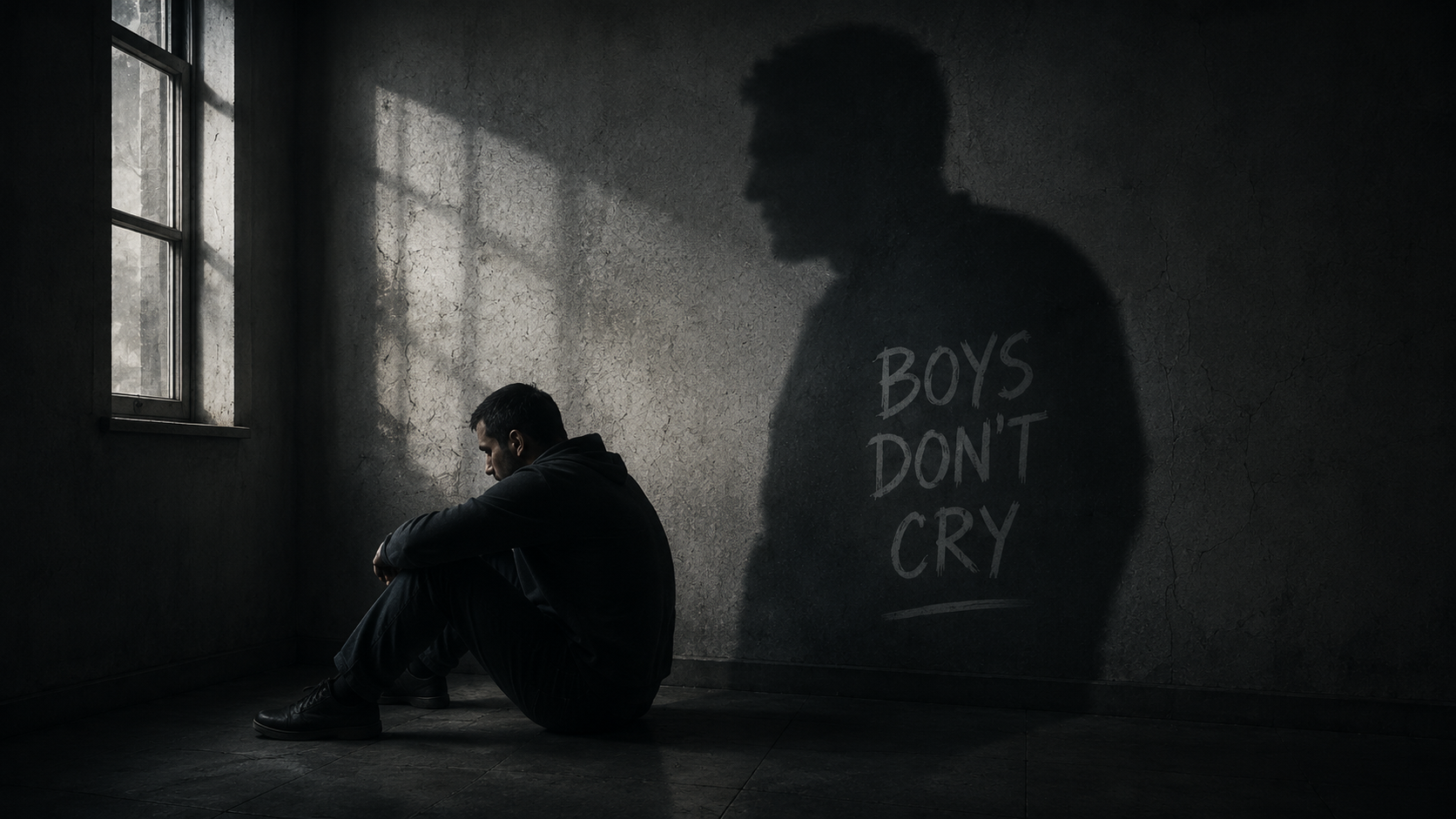
A Men’s Mental Health Awareness Month Reflection
As June comes to a close, so does Men’s Mental Health Awareness Month.
But for a lot of men, awareness is not the problem.
They are aware they are tired.
Aware they are angry.
Aware they shut down.
Aware they do not know how to talk about what is actually going on inside them.
Aware they feel disconnected from their partner, their kids, their body, their emotions, or themselves.
The problem is not always awareness.
Sometimes the problem is a rule they learned before they ever had the language to question it.
“Boys don’t cry.”
It sounds simple.
Old-fashioned, maybe.
Something said on playgrounds, in locker rooms, in living rooms, at ball fields, in garages, or from one generation to the next.
But that phrase was never just about tears.
It was a command.
Do not feel too much.
Do not need too much.
Do not show pain.
Do not make people uncomfortable with what you are carrying.
Do not let the world see where it hurts.
And when a boy hears that enough times, he adapts.
Not because he is weak.
Because he is young.
Because he wants approval.
Because he wants to belong.
Because the people around him teach him what parts of himself are acceptable.
So he learns.
He swallows the tears.
He tightens his jaw.
He turns sadness into anger because anger feels safer than vulnerability.
He says, “I’m fine,” because that gets people to stop asking.
He leaves the room before anyone sees his face change.
He learns to disappear inside himself while still looking like he is handling everything.
And over time, that boy becomes a man who may not even know what he feels anymore.
He just knows he is irritated.
Numb.
Restless.
Exhausted.
Short-tempered.
Disconnected.
Heavy.
He knows something is off.
He just may not know what to call it.
The Phrase Gets Handed Down
Most men who were told “boys don’t cry” were told that by someone who had also been trained not to cry.
A father may shut down his son’s emotions because no one knew what to do with his.
A grandfather may call softness weakness because softness was shamed out of him.
A coach may mock fear because he was taught performance mattered more than pain.
An uncle may laugh at tears because humor was the only way he learned to avoid discomfort.
That does not erase the damage.
But it explains the hand-off.
Emotional silence often gets passed down like an inheritance.
One generation learns to bury pain.
The next generation learns by watching.
Then the rule gets repeated.
Man up.
Shake it off.
Stop being soft.
Do not talk about it.
Do not cry.
Do not need help.
And after enough time, people start calling it strength.
But sometimes what looks like strength is really survival.
Sometimes the man who “handles everything” is not at peace.
He is just deeply trained to keep going no matter what it costs him.
The Tears Do Not Disappear
A boy can be trained out of crying.
But he cannot be trained out of having a nervous system.
He cannot be trained out of grief.
Or fear.
Or shame.
Or loneliness.
Or heartbreak.
He can only be trained to hide them.
And hidden pain does not become harmless.
It moves.
It shows up as anger.
Overworking.
Drinking.
Numbing out.
Pulling away.
Snapping at people who did not cause the original pain.
Avoiding hard conversations.
Feeling uncomfortable when someone asks, “Are you okay?”
Sitting in the garage longer than necessary because going back inside means being needed again.
Staring at the TV but not really watching it.
Making jokes when the conversation gets too close.
Saying “I don’t know” because the truth is buried too deep to reach quickly.
This is why “boys don’t cry” needs to stop.
Because the tears do not disappear.
They just change form.
Sometimes men cry through silence.
Sometimes they cry through anger.
Sometimes they cry through distance.
Sometimes they cry through exhaustion.
Sometimes they cry through the body.
Tension.
Tightness.
Headaches.
Stomach issues.
Sleep problems.
Chest pressure.
A body that feels like it is carrying something the mouth was never allowed to say.
“I’m Fine” Can Become a Wall
“I’m fine” is not always a lie.
Sometimes it is a reflex.
A man says it when he is overwhelmed.
When he is grieving.
When he is scared.
When he is lonely.
When he does not want to explain something he barely understands himself.
When he has spent years learning that being honest about pain makes other people uncomfortable.
Eventually, “I’m fine” becomes less of an answer and more of a wall.
A wall between him and his partner.
A wall between him and his children.
A wall between him and his own body.
A wall between the man people see and the man who is actually carrying the weight.
And the painful part is that many men do not even know the wall is there.
They just know connection feels hard.
They know emotions feel unsafe.
They know being asked to open up feels like being cornered.
They know they are tired of being angry, distant, numb, or shut down.
But they do not know how to get out of a rule they were praised for obeying.
Opening Up Is Not Always Simple
A lot of men’s mental health conversations say the same thing:
Men need to open up.
And yes, sometimes they do.
But for many men, opening up does not feel simple.
It feels exposed.
It feels weak.
It feels unfamiliar.
It feels like breaking a rule their whole system was built around.
So healing cannot only be about telling men to talk.
It has to go deeper than that.
It has to ask:
What taught him silence was safer?
What taught him emotions were dangerous?
What taught him anger was acceptable, but sadness was not?
What taught him needing support made him less of a man?
What did his body learn to protect him from?
Because if the shutdown started as protection, then judgment will not heal it.
Pressure will not heal it.
Shame will not heal it.
Another lecture about communication will not heal it.
The deeper pattern has to be seen.
A Different Kind of Strength
Real strength is not emotional silence.
Real strength is being able to tell the truth without abandoning yourself.
It is being able to say, “That hurt.”
It is being able to say, “I don’t know why I’m angry, but something underneath this is not okay.”
It is being able to look at the pattern instead of defending it.
It is being able to stop passing the same rule to the next generation.
Because the next boy does not need to inherit emotional silence.
He does not need to be trained out of his own humanity.
He does not need to learn that his tears make him less of a man.
And the men already carrying that rule do not have to keep obeying it forever.
“Boys don’t cry” needs to stop because boys do cry.
Men hurt.
The body remembers.
And what gets buried does not disappear just because no one taught you how to speak it.
If this hits something in you, pay attention.
Not with judgment.
With honesty.
Because sometimes the thing you were taught to hide is the exact place healing needs to begin.
At Sound Emotions Healing, I help people look beneath the surface at the emotional, subconscious, and body-based patterns that may still be shaping how they react, shut down, protect themselves, and move through life.
