
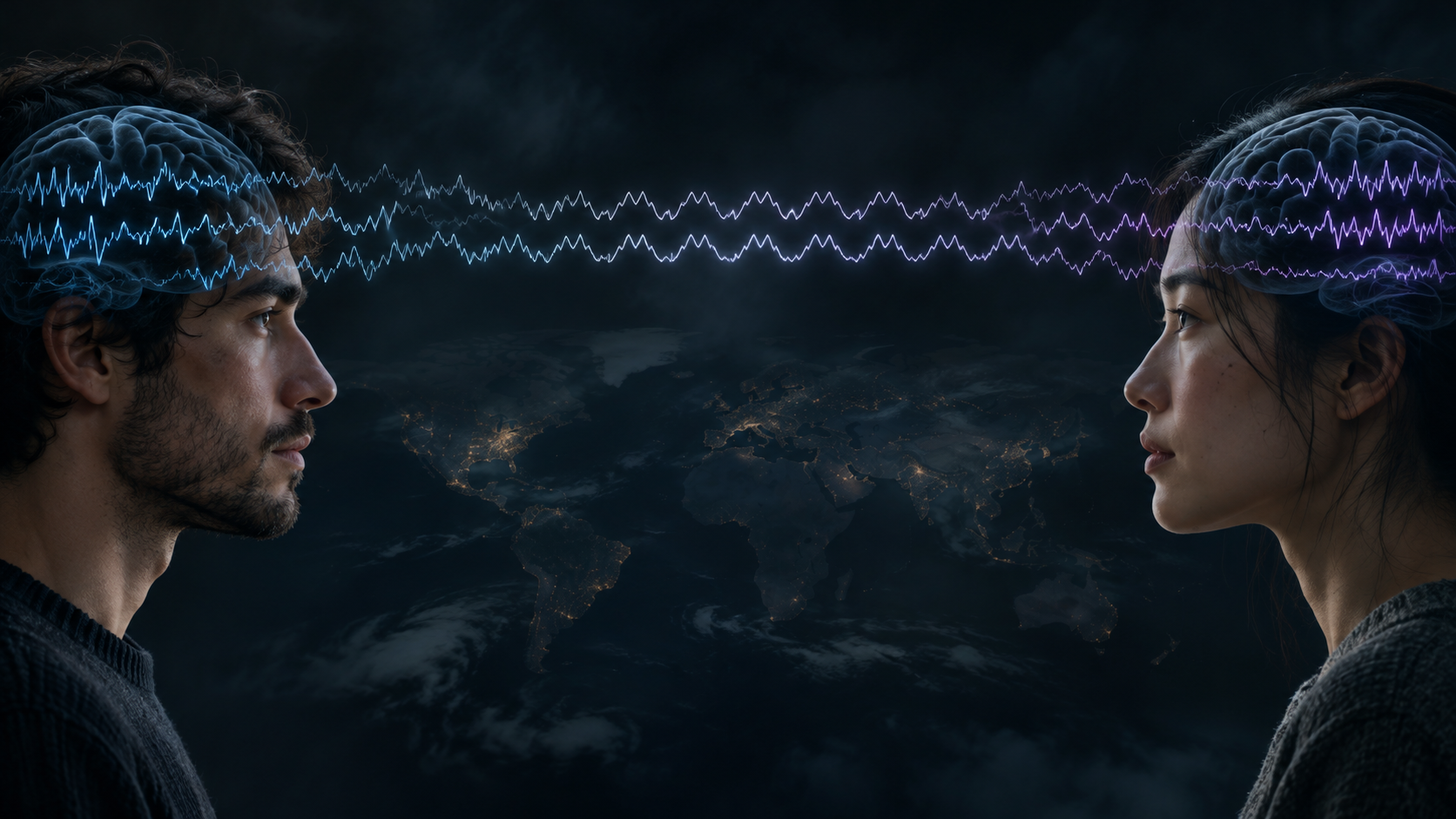
Have you ever said you were “on the same wavelength” as someone?
Usually we mean it figuratively.
You finish each other’s sentences.
You know what they’re going to say before they say it.
You walk into a room and immediately know your spouse is pissed off.
You haven't even taken your coat off yet, but somehow you know you're already in trouble.
For most of human history, “being on the same wavelength” was just an expression.
Today, scientists can actually measure something remarkably close to it.
When people interact, patterns of activity in their brains can synchronize.
Not spiritually.
Not metaphorically.
Measurably.
And once I learned that, I started wondering:
If two human brains can coordinate in ways we couldn't even observe until relatively recently, what else might be happening between us that we simply don't know how to measure yet?
Two separate brains can actually synchronize
Scientists use something called hyperscanning to record brain activity from two or more people at the same time while they interact.
In 2026, researchers published a systematic review and meta-analysis of 54 EEG studies examining inter-brain synchrony.
Overall, social interaction was associated with stronger synchronization between people's measured brain activity. The researchers also found an association between that synchrony and behavioral or cognitive outcomes.
Separate brains.
Separate nervous systems.
Yet during interaction, aspects of their electrical activity can show coordinated patterns.
Before we get carried away, this does not mean scientists discovered telepathy.
There are plenty of ordinary reasons two brains might become synchronized.
Two people may be hearing the same sounds.
Looking at the same thing.
Moving together.
Paying attention to each other.
Responding to the same environment.
The researchers themselves point out that this is complicated science and that shared stimulation, behavior and the way synchrony is measured all matter.
But that doesn't make it boring.
Think about what we're actually saying.
For thousands of years this was happening between people and nobody could see it.
Then our equipment became sophisticated enough to detect it.
The phenomenon didn't suddenly appear.
Our ability to observe it did.
Then I started thinking about families
Researchers have also been looking at what happens between parents and children.
A 2026 review found growing evidence that parents' and children's brains can display neural similarity and synchrony during shared activities, emotional exchanges and everyday interactions.
Another recent review looking at natural parent-child interactions found higher neural synchrony was most consistently associated with things like mutual engagement, shared positive emotion and supportive parenting.
The authors were careful not to claim that one person's brain was simply causing changes in the other's. But they did find that the coordination changes along with what's happening between parent and child.
Research with infants goes even further.
Parent-infant synchrony is described as bidirectional.
Parent affects child.
Child affects parent.
Their physiological, neural and behavioral states continually adjust to one another.
That got my attention because I've seen something interesting in my own work.
Sometimes I work with one person and the household changes
Most of my work is one-on-one.
But sometimes after working with somebody I'll hear:
“My kid seems different.”
“The house has been calmer.”
“My husband reacted differently.”
“Things just don't seem as tense.”
I've especially noticed it with children.
Now, that doesn't mean I somehow worked on everyone in the house.
There may be a perfectly reasonable explanation.
If Mom becomes less reactive, her child is now interacting with a different version of Mom.
If Dad doesn't get triggered the same way, his child gets a different response.
That changes what the child does next.
Which changes what the parent does next.
And suddenly the entire interaction is moving differently.
One piece of the system changed.
Everything connected to it had to adjust.
That alone is fascinating.
And now we're discovering measurable neural and physiological coordination between parents and children that gives us another window into just how connected human relationships really are.
But does that explain everything I've observed?
I don't know.
And that's where my curiosity starts.
Reality was there before the equipment
Imagine explaining radio waves to someone a thousand years ago.
You tell them invisible signals are passing through the air around them carrying voices and information from one place to another.
They can't see them.
Can't hear them.
Can't feel them.
But one day we'll build equipment capable of detecting those signals and translating them into sound.
You'd probably have a difficult afternoon.
But radio waves didn't suddenly start existing when we developed radio receivers.
Reality was already doing what reality does.
We eventually figured out how to detect part of it.
That's why I think we need to be careful about confusing:
“We don't currently know how to measure that.”
with:
“That cannot possibly exist.”
Those aren't the same thing.
So could telepathy be real?
There it is.
The weird question.
Does brain synchrony prove telepathy?
No.
There is no established evidence showing that one person's thoughts simply travel into another person's mind without ordinary sensory communication.
But here's something that would have sounded equally ridiculous not very long ago.
Scientists have already created technology-assisted brain-to-brain communication.
In a 2019 experiment called BrainNet, researchers connected three people using EEG and transcranial magnetic stimulation.
Two people acted as “senders.”
Their brain activity was used to determine decisions they were making in a Tetris-like game.
That information was transmitted over the internet and delivered into the brain of a third participant, who used it to help make a decision.
Five groups successfully used the system, with average task accuracy of 81.25 percent.
Let's be clear.
That's not telepathy.
Machines did the translating and transmitting.
But information originating in one person's brain was detected and delivered to another person's brain.
That exists.
Imagine trying to explain that several hundred years ago.
Which sounds crazier?
Telepathy?
Or a machine that reads electrical activity from your brain, sends the information through an invisible network and introduces it into another person's brain using magnetic stimulation?
We already built one of them.
So perhaps the better question isn't:
“Has science proven telepathy?”
It hasn't.
Maybe the better question is:
“Do we already know every possible way human beings can exchange information?”
I don't know how we could honestly answer yes.
Then there's remote viewing
Now things get even stranger.
Remote viewing is the claimed ability to obtain information about a distant or unseen location without using the normal senses.
Sounds pretty far out there.
Apparently not far enough for the United States government to ignore it.
The CIA and U.S. military spent years investigating remote viewing and related phenomena through programs that eventually became associated with STARGATE.
And they didn't just play around with it.
Between 1986 and the first quarter of 1995, the program received more than 200 operational tasks from military organizations asking remote viewers to attempt to obtain information unavailable through ordinary sources.
More than 200.
Eventually, the program was discontinued.
The final evaluation found that the information produced wasn't dependable enough to establish operational usefulness for intelligence purposes. It was often ambiguous and subjective.
That's important.
But here's what makes the story interesting.
The CIA's own historical account says the independent evaluation found enough accurate remote-viewing experiences to challenge an explanation based purely on randomness, while also concluding that the phenomenon was too inconsistent and unreliable to be useful for intelligence operations.
So...
what exactly were they seeing?
Bad methodology?
Coincidence?
Statistics being interpreted incorrectly?
Subtle information leaking into the experiments?
Something psychological we already understand?
Something we don't?
I don't know.
That's why it's interesting.
And this is where it stops being theoretical for me
Years ago, I investigated supposedly haunted places.
Today, my work is different, but apparently I still haven't completely escaped strange questions.
I'm certified in Emotion Code, Body Code and Belief Code.
Most of my sessions are remote.
That means I can be sitting in my office in Wisconsin while the person I'm working with is hundreds or even thousands of miles away.
We're talking on the phone.
I'm doing the work here.
They're there.
And oftentimes afterward they tell me something changed.
An emotional reaction feels different.
Something that normally gets under their skin doesn't have the same charge.
Physical tension may feel different.
Sometimes, as I mentioned earlier, they even report that something seems different within the household afterward.
Does current science provide an established mechanism demonstrating that something I'm doing in Wisconsin directly causes a change in someone across the country?
No.
I'm not going to pretend it does.
But the client may have another opinion about whether something happened.
And that's where I find myself stuck with the same question.
What am I supposed to do with the experience?
I could decide:
“Obviously I transmitted energy across the country. Mystery solved.”
That would be a pretty big conclusion.
Or I could decide:
“Science doesn't currently explain this, so whatever the client experienced doesn't count.”
That doesn't make much sense to me either.
Their experience doesn't prove the mechanism.
But human observation has always been where questions begin.
Something happens.
Somebody notices.
Then we try to figure out why.
And this area hasn't been completely ignored by researchers.
A recent review identified 353 clinical studies of practices generally categorized as biofield therapies, including 255 randomized controlled trials and a smaller number specifically involving distant or remote healing.
That doesn't mean science has proven distant healing.
It hasn't.
Research quality and results vary, and big questions remain.
But again, I find the question itself more interesting than pretending we've already settled it.
People report experiences.
Researchers investigate.
Some findings raise questions.
And we still don't have an established explanation for how a distant effect would occur.
Fine.
Then keep asking.
So where does connection end?
We now know that interacting human brains can display measurable synchronization.
Parents and children can show coordinated neural and physiological patterns while interacting.
We've built technology capable of transmitting information detected from one human brain to another.
The United States government spent years investigating whether people could somehow obtain information from distant locations.
And every week I sit in Wisconsin and work remotely with people around the country who sometimes tell me they experienced changes during or after our work together.
None of those things proves the next one.
That's important.
But together they leave me with a question I'm becoming increasingly uncomfortable pretending we already know the answer to:
How much do we actually understand about the ways human beings are connected?
Maybe someday science will explain exactly what happens in the kind of remote work I do.
Maybe the explanation will be far more ordinary than people imagine.
Maybe it'll be stranger.
Maybe some of what we currently believe about these things will turn out to be completely wrong.
I don't know.
But “I don't know” isn't where curiosity ends.
It's where it begins.
A century from now, people may look back at some of the things we consider impossible today and laugh at us.
They'll probably laugh at plenty of things we currently believe too.
That's how this seems to work.
Reality doesn't begin when we understand it.
It doesn't wait for a study to approve it.
And it doesn't require our permission to exist.
Science is one of the ways we try to understand what's already there.
Which once again leaves me with the question behind this entire series:
Who decides what's real?
Maybe nobody does.
Maybe reality has been there the entire time...
waiting for us to catch up.
