
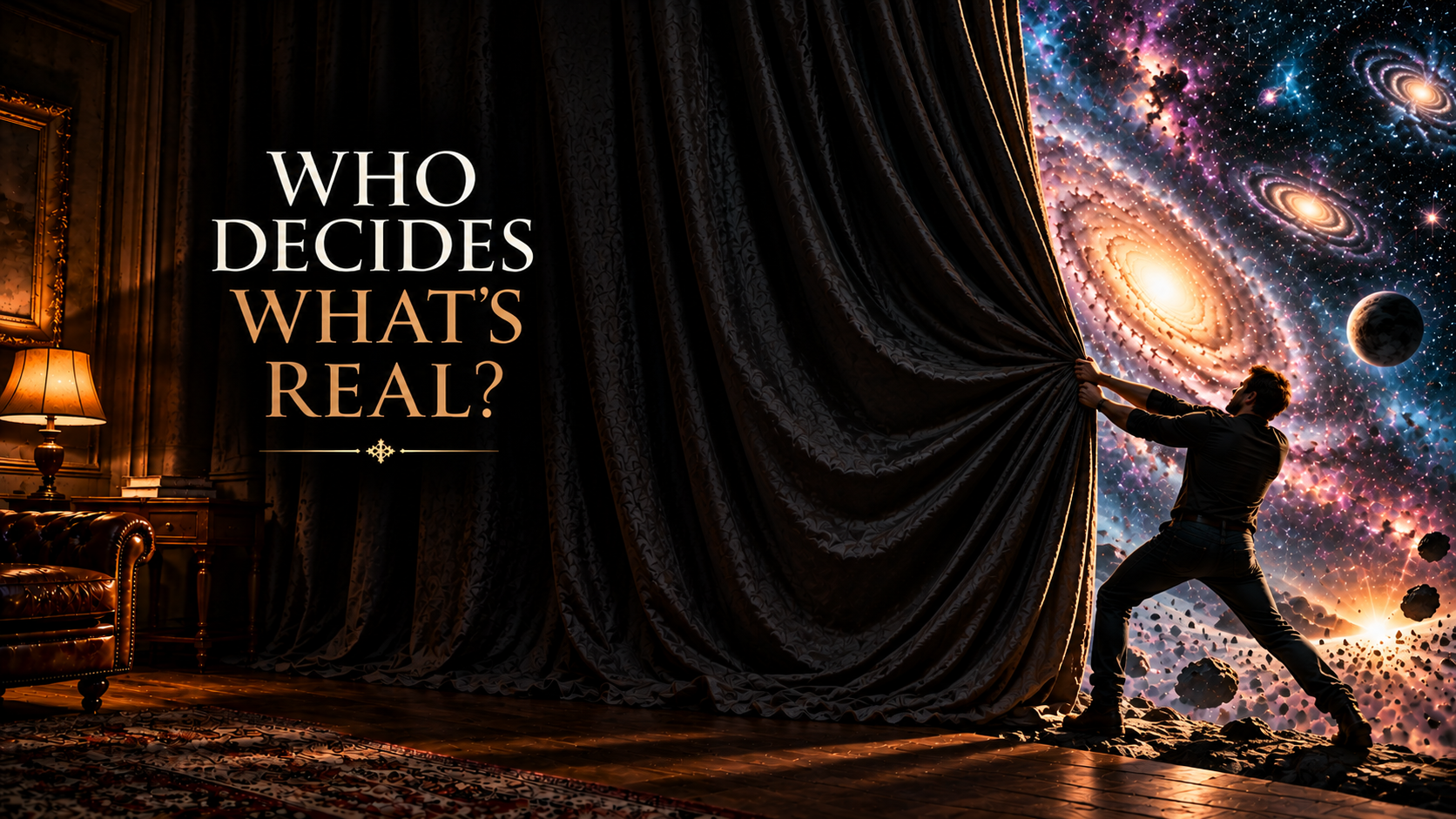
Who Decides What's Real?
And how much of the life we're living was decided for us?
We spend most of our lives chasing something we invented.
Money.
Think about it.
We get up before the sun.
Spend eight, ten, sometimes twelve hours working.
We do that five days a week, sometimes more.
We trade our time for numbers deposited into a bank account.
Then we use those numbers to pay for the house we sleep in, the vehicle that gets us to work, and the food that keeps us alive long enough to do it all over again tomorrow.
We borrow numbers we don't have to buy things we need.
Then spend years paying those numbers back, plus interest.
And if everything goes according to plan, we might eventually retire.
For Americans born in 1960 or later, the full Social Security retirement age is 67.
Sixty-seven.
And we're supposed to call that success?
Now, I'm not saying there's anything wrong with working, earning money, or planning for retirement.
But step outside everything we've been taught for a moment.
Who the hell decided this was how human beings were supposed to live?
Because here's something interesting.
On this same planet, there are communities where people live very differently.
Different priorities.
Different relationships with money.
Different ideas about what makes a successful life.
And some of them report being remarkably happy.
The people who didn't get the memo
In 2024, researchers published a study involving nearly 3,000 people across 19 Indigenous and local communities on five continents.
Many lived in small-scale societies that relied heavily on the natural environment for their livelihoods.
Thirty-six percent of the households reported having no cash income during the study period.
By the financial standards most of us use to measure success, many of these people had very little.
But when researchers asked participants to rate their satisfaction with life, the average was 6.8 out of 10.
Four communities scored above 8.
Comparable to some of the world's wealthiest countries.
Think about that.
We live in a society where people spend enormous amounts of time chasing financial security, bigger houses, better vehicles, and eventually the freedom to stop working.
Yet here were communities reporting high life satisfaction without the monetary wealth we've been taught is so important.
Their lives aren't necessarily easier. They face hardships of their own, and not every community reported high satisfaction.
But the research raises an interesting question.
Have we confused the way we've organized our lives with the way life is supposed to be?
Because those aren't necessarily the same thing.
The strangest thing about money
Take a hundred-dollar bill.
It's a piece of paper with some ink on it.
Okay, technically it's a specialized cotton-and-linen blend, but you get my point.
You can exchange it for groceries, gasoline, or a nice dinner.
Why?
Because we've collectively agreed it has value, supported by laws, institutions, and an economy built around that agreement.
The paper itself isn't worth a hundred dollars.
The agreement is.
But here's where it gets even stranger.
When was the last time you actually held a hundred-dollar bill?
Most of us don't even see the money we're working for anymore.
We put in our hours.
A number appears in a bank account.
We buy groceries.
The number gets smaller.
We pay the mortgage.
More numbers disappear.
We swipe a card, tap a phone, or click a button, and numbers move from one account to another.
Nobody hands us anything.
There isn't a pile of cash being passed back and forth.
Just electronic records representing value within a financial system we've built and agreed to recognize.
And based on those numbers, we determine where we can live, what we can afford, whether we can take a vacation, and how many more years we'll have to work.
Think about that.
We've organized nearly our entire existence around something most of us never physically touch.
And that arrangement has very real consequences.
People have built fortunes around it.
Lost everything because of it.
Spent their entire lives pursuing it.
And sometimes sacrificed their health, relationships, and happiness trying to accumulate more of it.
I'm certainly not suggesting we stop using money.
My grocery store probably wouldn't appreciate me offering them a handful of pinecones for a steak.
But it's fascinating when you think about it.
Something humanity created has become one of the most powerful forces determining how humanity lives.
We created the system.
Then generations were born into it.
And eventually, for many of us, it stopped feeling like a system we created.
It simply became reality.
But money is only one example.
What happens when someone decides what you're allowed to believe?
Let's go back several hundred years.
In 1478, the Spanish Inquisition was established under the authority of the Spanish monarchy and the Catholic Church.
It was created to investigate suspected religious heresy, particularly among people who had converted to Christianity.
What followed was centuries of religious persecution, coercion, imprisonment, and punishment.
People could face severe consequences for beliefs and religious practices that authorities deemed unacceptable.
Imagine living in a world where expressing the wrong belief could threaten your freedom, your livelihood, or your life.
The authorities weren't simply saying they disagreed with you.
They had the power to punish you for disagreeing with them.
And many believed they were defending religious truth.
Think about that.
People could face imprisonment or worse because an institution had decided which beliefs were acceptable.
The Spanish Inquisition was finally abolished in 1834.
Thank God.
But here's something I've been wondering.
Did humanity actually outgrow the tendency to punish people for challenging accepted beliefs?
Or did we simply find different ways of doing it?
Now, I'm not suggesting modern public-health rules were equivalent to centuries of religious persecution, torture, and executions.
They weren't.
But the underlying human behavior is worth examining.
A group of people becomes convinced they're defending what's right.
Their beliefs become the accepted truth.
And somewhere along the way, disagreement stops being a question of evidence and starts being a question of someone's character.
Their loyalty.
Their morality.
Whether they're a good person.
Suddenly, we're no longer asking whether something is true.
We're asking what's wrong with the person who dares to question it.
And once people convince themselves they're acting for the greater good, how far are they willing to go in their treatment of those who disagree?
That's a question worth asking in any century.
Because before we congratulate ourselves on being so much more enlightened today, maybe we should look at something a little closer to home.
Remember when questioning became a problem?
Remember the COVID-19 pandemic?
Of course you do.
How could you forget?
For a period of time, practically every aspect of our lives came with a new set of instructions.
Stand six feet apart.
Wear a mask.
Don't gather with people outside your household.
Don't go to the beach.
Show proof of vaccination to enter certain restaurants.
And depending on where you lived, you might have been required to wear a mask while walking into a restaurant, only to remove it once you sat down to eat.
I thought that rule was ridiculous then.
I still do.
You can explain the intention behind a rule all day long. That doesn't automatically make it sensible.
And here's where things get interesting.
In 2024, Dr. Anthony Fauci testified before Congress about the six-foot distancing guideline.
He acknowledged there hadn't been a controlled trial establishing that six feet was better than three or ten feet.
The CDC had relied on earlier research and understanding of respiratory droplets.
But the exact distance hadn't been established through direct comparative testing.
Yet millions of people were expected to organize their lives around it.
Then there was the messaging about vaccines.
When Pfizer's COVID-19 vaccine was first authorized, its clinical trials had demonstrated protection against symptomatic disease, but they hadn't established whether it prevented transmission.
That uncertainty was publicly disclosed.
Later research showed that vaccination could reduce infection risk, particularly early on.
But in July 2021, President Biden told a CNN audience that vaccinated people wouldn't get COVID-19.
That was more certainty than the evidence justified.
And all the while, enormous amounts of money were changing hands.
Pfizer reported approximately $37.8 billion in COVID-19 vaccine revenue in 2022 alone.
Medicare also provided additional payments for eligible COVID-19 hospitalizations.
Those financial arrangements don't automatically prove wrongdoing.
But shouldn't enormous financial interests make transparency and independent scrutiny even more important?
Since when did questioning a financial incentive become unreasonable simply because the money was being made in the name of public health?
And then came something I found even more disturbing.
We started turning against each other.
Families argued over vaccination.
Friends stopped speaking.
People were excluded from gatherings.
A September 2021 Economist/YouGov poll found that more than one-quarter of vaccinated American adults with unvaccinated friends or relatives had stopped associating with at least one of them over vaccination status.
Think about that.
People who had spent their entire lives loving one another suddenly found themselves divided over decisions made during a public health emergency.
COVID-19 was considered a serious disease. People died. People were frightened, and many were genuinely trying to protect those they loved.
But fear doesn't make every decision correct.
And good intentions don't eliminate the need to examine consequences.
Businesses closed.
Children missed school.
Relationships fractured.
And for some people, "follow the science" stopped being an invitation to examine evidence and became a demand for obedience.
But science isn't a religion.
It isn't supposed to be a collection of commandments nobody is allowed to question.
Science is a process.
It asks questions.
Tests explanations.
Finds mistakes.
And changes its conclusions when better evidence comes along.
Questioning whether a particular mandate was effective, proportionate, or worth its social cost was legitimate.
It should have been treated that way.
Because here's something we shouldn't forget.
Being uncertain about a rule isn't the same thing as being uncertain about the existence of a disease.
And questioning authority isn't the same thing as rejecting evidence.
That distinction matters.
Especially when the decisions being made affect millions of lives.
And perhaps that's the connection worth remembering from our history.
We don't need to repeat the exact mistakes of previous generations to repeat some of the thinking that made those mistakes possible.
Any time we become so convinced of our own righteousness that we stop questioning how we're treating other people, we should be concerned.
Regardless of which side we're on.
Because certainty can be a dangerous thing when it's accompanied by power.
What if our senses aren't telling us the whole story?
Now let's move away from governments, corporations, and institutions for a moment.
Because there's another problem with our understanding of reality.
What if the world itself isn't anything like what we think we're experiencing?
I came across a meme recently that claimed if you removed all the empty space from the atoms making up humanity, everyone who ever lived could fit inside something smaller than a sugar cube.
The size claim gets exaggerated.
But the actual physics behind it is astonishing.
Nearly all the mass of an atom is concentrated inside an unimaginably tiny nucleus.
The rest of the atom is described by electrons and the interactions that govern their behavior.
And those interactions help explain why the world around us feels solid.
Let that sink in.
The table you're sitting at feels perfectly solid.
Yet at the atomic level, its structure is nothing like the solid block our senses suggest.
Of course, my little toe still believes the coffee table is solid.
And after enough encounters, I'm inclined to agree with it.
But the point remains.
The deeper we investigate reality, the more we discover that the world doesn't necessarily operate the way our everyday experiences suggest.
And here's another interesting discovery.
Have you ever met someone and felt like you were immediately on the same wavelength?
We've used that expression for years.
Researchers have now measured patterns of synchronized brain activity between people participating in shared experiences.
In one experiment, scientists recorded the brain activity of students during regular classroom activities.
They discovered that synchronized activity was associated with engagement and social dynamics.
Think about that.
Something we've described for generations as being on the same wavelength has a measurable counterpart in neuroscience.
Does that explain everything about human connection?
Not even close.
But it opens up some fascinating questions.
And that's what interests me.
How many things exist right now that we simply haven't developed the tools, knowledge, or understanding to recognize?
How many things do we dismiss because they don't fit our current explanations?
And how many things that seem mysterious today will be ordinary knowledge a hundred years from now?
I've spent years exploring things people disagree about.
I used to investigate the paranormal.
Today, I work with energy healing.
So I've had my share of conversations about what's real, what's possible, and what's complete nonsense.
And I've noticed something.
Some people will reject an idea before they've investigated it.
Others will believe almost anything that sounds unusual.
Neither approach strikes me as particularly useful.
Just because someone has an impressive title doesn't mean they've discovered the final answer.
And just because somebody challenges an established explanation doesn't mean they're right.
Question everything. Including the people telling you to question everything.
Because replacing one authority with another isn't independent thinking.
Sometimes investigation reveals that something mysterious has an ordinary explanation.
Sometimes the evidence confirms what we already understood.
And sometimes a discovery changes everything.
That's what makes it worth investigating.
But there's another obstacle.
And I think this one might be the hardest to overcome.
How willing are we to discover that something we've believed our entire lives is wrong?
Think about it.
What if you've spent decades building a career, a reputation, or even your identity around a particular understanding of the world?
And suddenly compelling evidence challenges it.
Would you welcome that discovery?
Or would you fight to protect what you already believe?
I think that's a question every one of us should occasionally ask ourselves.
Including me.
Because if we're only interested in evidence that supports what we already believe, we're not searching for truth.
We're searching for confirmation.
And there's a big difference.
Maybe the curtain isn't always hiding the same thing.
When I think about reality, I picture an enormous curtain.
Behind it is everything we haven't discovered, everything we haven't understood, and perhaps some things we've been discouraged from questioning.
Sometimes nobody knows how to open the curtain.
We simply don't have the knowledge or tools yet.
Sometimes, history has shown us, people with something to protect would rather keep it closed.
And sometimes?
Maybe we're the ones holding the curtain shut.
Maybe we're so attached to the world we've been taught to believe in that we're afraid to discover something different.
The idea that success means accumulating more money.
That adulthood means spending most of your life working.
That certain people or institutions must have all the answers.
That the world operates exactly as we've been told.
And that anyone who challenges those ideas must be wrong.
But what if some of those things aren't reality itself?
What if they're simply the version of reality we've learned to accept?
Two hundred years from now...
Imagine someone looking back at our civilization in the year 2226.
Our jobs.
Our economy.
Our medical practices.
Our understanding of consciousness.
Our beliefs about what's possible.
What will they admire?
What will they find ridiculous?
What will they wonder how we could have missed?
Maybe they'll discover things that fundamentally change our understanding of the physical universe.
Maybe they'll live in societies organized around completely different ideas of success, wealth, and happiness.
Maybe they'll recognize assumptions that we never even thought to question.
I don't know.
But I suspect they'll understand some things we don't.
And they'll probably still have plenty left to discover themselves.
Because reality doesn't require our understanding to exist.
And it certainly doesn't require anyone's approval.
Reality doesn't need our permission to be real.
We've been wrong before.
Spectacularly wrong.
We've been deliberately misled.
And we've accepted entire systems of living without ever stopping to ask who created them or why.
We spend decades working for money we've collectively agreed has value.
We measure success by things that might mean absolutely nothing to someone living on the other side of the planet.
And we allow institutions, governments, and people we've never met to influence what we believe is possible.
Then we call it reality.
So question the institutions.
Question the experts.
Question the people challenging the experts.
Hell, question me.
But whatever you do, don't spend your entire life accepting somebody else's version of reality without ever examining it for yourself.
Because here's something worth considering.
What if the life you've been working so hard to succeed at isn't even the life you would have chosen if someone hadn't taught you what success was supposed to look like?
Think about that.
Shawn O'Leary
Sound Emotions Healing
Research and historical references
High life satisfaction reported among small-scale societies with low incomes, PNAS, 2024.
Full Social Security retirement age for those born in 1960 or later, Social Security Administration.
Money and Payments: The U.S. Dollar in the Age of Digital Transformation, Federal Reserve.
The Spanish Inquisition, Encyclopaedia Britannica.
Dr. Anthony Fauci's June 2024 congressional hearing transcript.
Pfizer's original vaccine trial and transmission testing, FactCheck.org.
Medicare's COVID-19 inpatient payment policies, Centers for Medicare & Medicaid Services.
How COVID vaccination views divided families and friendships, YouGov, 2021.
Atomic nuclei and the structure of matter, U.S. Department of Energy.
Brain-to-brain synchrony in classroom interactions, Current Biology, 2017.
