
My Life Is Good. Why Am I Still Unhappy?
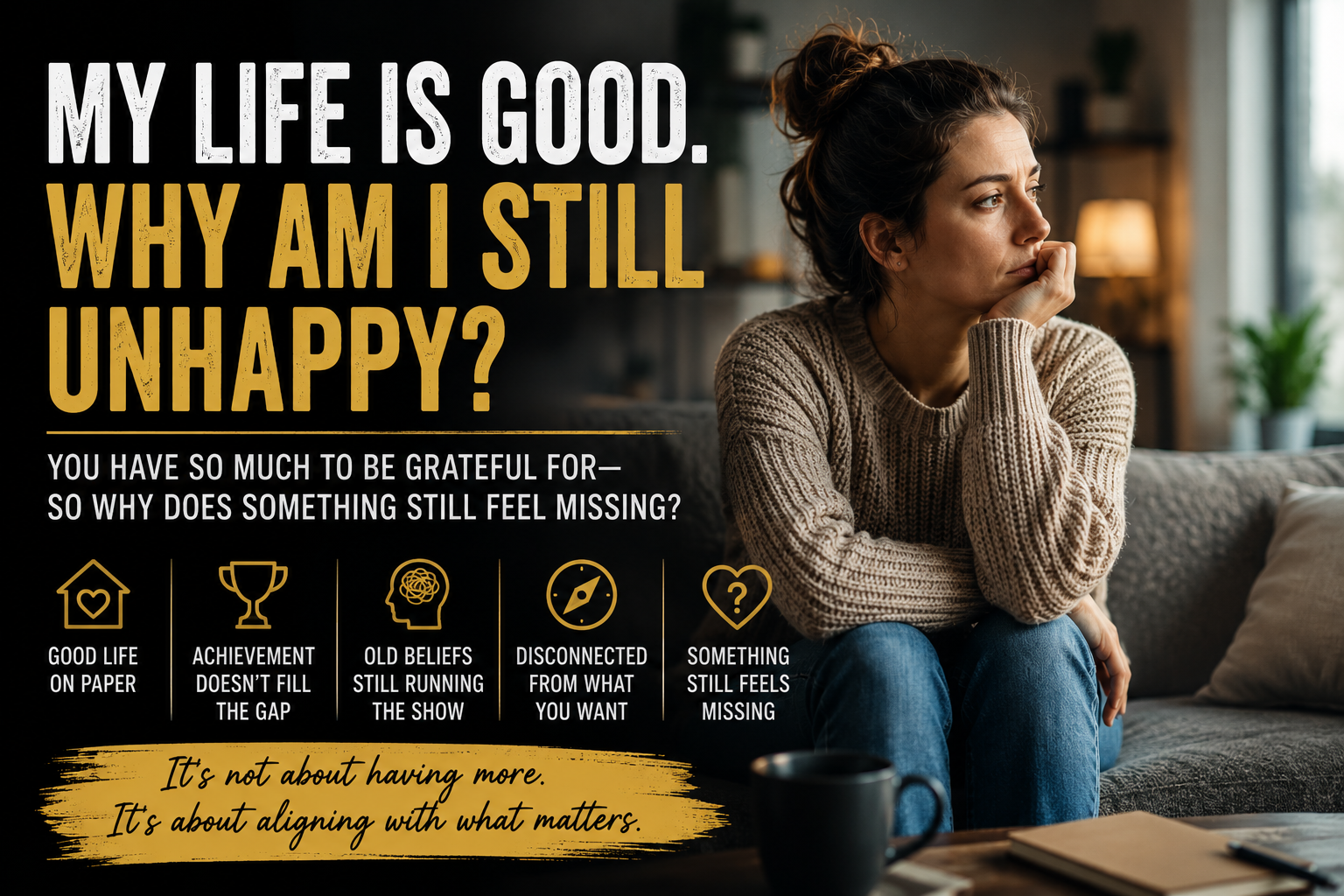
On paper, things are fine.
Maybe even good.
You have a job.
A home.
People who care about you.
Maybe a relationship.
Maybe a family.
You’re not in some obvious crisis.
And still, something feels off.
You wake up and go through the motions.
You do what needs to be done.
You handle responsibilities.
You keep moving.
But underneath all of it is this nagging thought:
Why am I not happier than this?
Sometimes that question is followed by guilt.
Because you know other people have it worse.
You know there are things in your life you should be grateful for.
You may even feel embarrassed admitting that something is missing.
So you tell yourself:
I shouldn’t feel this way.
But that doesn’t make the feeling go away.
Having a Good Life and Feeling Good About Your Life Are Not the Same Thing
This is easy to miss.
You can build a life that looks good from the outside and still feel disconnected from it.
You can have stability without fulfillment.
Success without peace.
A relationship without closeness.
A career without meaning.
A busy life without feeling like it belongs to you.
That doesn’t make you ungrateful.
It means external circumstances and internal experience are not always the same thing.
You can fix a lot of things outside yourself and still carry the same reactions, beliefs, expectations, and emotional patterns into the new situation.
The scenery changes.
You come with you.
Sometimes You’ve Been Chasing the Next Thing for Years
Get the job.
Then things will feel better.
Make more money.
Then you’ll relax.
Find the relationship.
Then you’ll feel complete.
Buy the house.
Lose the weight.
Get promoted.
Reach the goal.
You hit one milestone.
There’s a brief sense of relief.
Then another goal appears.
And eventually you realize:
I keep getting what I thought I wanted, but it never seems to last.
That can be confusing.
Because if the problem was supposed to be the job, the money, the relationship, or the achievement...
why are you still carrying the same dissatisfaction?
Sometimes the goal wasn’t the problem.
Sometimes you were asking the goal to fix something it was never capable of fixing.
Achievement Can’t Always Change the Story Underneath
Suppose part of you learned:
Then you become successful.
For a little while, success feels like proof.
But eventually the old belief finds a way back in.
You compare yourself to someone doing better.
You decide you should have achieved more by now.
You worry you’ll lose what you built.
You dismiss what you’ve accomplished.
You raise the standard.
Now you need the next thing.
Success can become an attempt to finally prove:
See? I matter.
But if the deeper belief never changes, the proof never quite sticks.
Why Do I Feel Like Something Is Missing?
Sometimes nothing obvious is missing.
That’s what makes it difficult to explain.
You may have everything you once thought would make you happy.
And still feel like you’re watching your own life from the outside.
That “something is missing” feeling can come from many places.
Maybe you’ve built your life around what you were supposed to want.
Maybe you’ve spent years being responsible for everyone else.
Maybe you’ve become very good at performing a role.
The good employee.
The dependable spouse.
The strong one.
The caretaker.
The successful one.
The one who never complains.
And somewhere along the way, you stopped asking:
What do I actually want?
You Can Become Very Good at Living a Life That Doesn’t Quite Fit You
This doesn’t mean you need to blow up your life.
Sometimes people hear “unfulfilled” and immediately imagine quitting their job, leaving their marriage, moving across the country, and buying a motorcycle.
Maybe don’t start there.
The issue may not be that everything in your life is wrong.
It may be that your relationship with your life has changed.
Maybe the person who built this life is not exactly the person you are now.
Values change.
Priorities change.
You change.
And sometimes we keep living according to decisions made by an earlier version of ourselves because changing direction feels irresponsible, selfish, risky, or confusing.
“I Should Be Happy” Can Make You Feel Worse
This phrase sounds reasonable:
I should be happy.
But it can turn into a trap.
Now you’re not only unhappy.
You’re judging yourself for being unhappy.
You have a decent life, so what’s wrong with you?
Why can’t you appreciate it?
Why are other people satisfied when you aren’t?
That turns dissatisfaction into shame.
And shame rarely makes anything clearer.
A better question might be:
What is this feeling trying to tell me?
Not:
What is wrong with me for having it?
Maybe You’ve Spent Years Surviving Instead of Choosing
Sometimes life gets built reactively.
You do what needs to be done.
You take the job because you need the money.
You stay because people depend on you.
You become responsible because nobody else is.
You learn to keep the peace.
You push through.
You handle it.
Years later, life finally becomes more stable.
But you never really switched out of survival mode.
You’re still solving.
Managing.
Preparing.
Holding everything together.
And now the emergency is gone, but you’re not sure how to live without one.
That can feel a lot like emptiness.
Why Do I Feel Empty When I Have Everything?
Because “everything” usually means the things we can point to.
Job.
House.
Money.
Relationship.
Family.
Health.
Stuff.
Those things matter.
But they don’t automatically create:
meaning.
connection.
self-respect.
freedom.
identity.
purpose.
peace.
a sense that your life reflects who you are.
You can have the checklist and still miss the experience.
That doesn’t mean you should throw away what you have.
It means the next question may need to be deeper than:
What else should I get?
You May Be Living by Rules You Never Chose
A lot of people build their lives around invisible rules.
Be responsible.
Don’t disappoint anyone.
Work hard.
Don’t complain.
Stay productive.
Don’t waste opportunities.
Take care of your family.
Be grateful.
Keep going.
Again, none of those are bad.
But they become a problem when there is no room left for:
What do I enjoy?
What matters to me?
What kind of life actually feels like mine?
What would I choose if I wasn’t trying to meet someone else’s expectations?
Sometimes dissatisfaction is not telling you that your life is bad.
It’s telling you that too much of it may have been built around obligation.
People-Pleasing Can Create a Life You Don’t Recognize
If your decisions are heavily influenced by other people’s comfort, approval, or expectations, your life can slowly move away from you.
You choose the practical job.
Stay in the safe relationship.
Say yes.
Avoid conflict.
Take care of everyone else.
Become dependable.
People appreciate you.
You look successful.
But internally you may feel resentful, exhausted, or strangely invisible.
Because everybody else has a place in your life.
You’re not sure where you do.
Sometimes Happiness Feels Unsafe Too
This may sound strange.
But if your system is used to stress, struggle, instability, or constant responsibility, calm can feel unfamiliar.
You finally have a good period.
And instead of settling into it, you start waiting.
Something will go wrong.
This won’t last.
I shouldn’t get too comfortable.
You scan for the problem.
Create one.
Or simply never fully let yourself enjoy what is happening.
Not because you consciously want misery.
Because your system may know how to survive struggle better than it knows how to trust peace.
The Nervous System Doesn’t Automatically Update When Life Improves
Your circumstances can change quickly.
Your learned responses may take longer.
Maybe you spent years having to stay alert.
Years expecting rejection.
Years managing conflict.
Years worrying about money.
Years feeling responsible for everyone.
Then life gets better.
But some part of you is still operating according to the old environment.
So even when nothing is wrong, your body stays tense.
You keep overthinking.
You keep anticipating problems.
You keep feeling like you should be doing more.
You keep waiting for the next thing to go wrong.
The old problem leaves.
The old expectation stays.
Sometimes You’re Still Trying to Earn Something
Approval.
Worth.
Love.
Respect.
Security.
Permission to relax.
Permission to be proud of yourself.
Permission to enjoy your life.
So you keep doing more.
You keep proving.
You keep achieving.
But the permission never arrives.
Because somewhere underneath is the belief:
Not yet.
You haven’t earned it yet.
That can create a life full of accomplishments and almost no satisfaction.
Why Do I Feel Unfulfilled?
Fulfillment usually has something to do with alignment.
Does the way you live match what actually matters to you?
Does your work reflect anything you care about?
Do your relationships allow you to be known?
Do you have room in your life for curiosity, creativity, connection, contribution, growth, or whatever matters to you?
Or is most of your life built around avoiding problems?
There’s a big difference between:
building toward something
and
spending your life preventing things from going wrong.
Both can keep you busy.
Only one tends to feel meaningful.
Maybe You’ve Outgrown the Life You Worked So Hard to Build
This can be uncomfortable to admit.
Because you may have fought hard to get here.
You wanted this.
Maybe you sacrificed for it.
So how can you now say it doesn’t completely fit?
Because people change.
The life that once represented freedom can later feel limiting.
The job that once represented success can become empty.
The identity that once helped you survive can become exhausting.
That doesn’t mean the earlier choice was wrong.
It may simply mean the choice served its purpose.
Sometimes growth requires allowing an old dream to become complete.
Your Unhappiness May Be Trying to Point Somewhere
Not every uncomfortable feeling needs to be eliminated immediately.
Sometimes it carries information.
Maybe it’s pointing toward:
a relationship that no longer works.
a version of success you don’t actually want.
a part of yourself you’ve ignored.
a life built around fear.
a belief that you must constantly prove yourself.
a need for more connection.
a need for boundaries.
a need to stop living entirely for everyone else.
a desire you’ve spent years talking yourself out of.
The feeling may not be the enemy.
It may be the first honest signal you’ve allowed yourself to notice in a long time.
This Doesn’t Mean Every Period of Unhappiness Has a Hidden Emotional Pattern
Life has seasons.
You can be tired.
Burned out.
Grieving.
Lonely.
Physically unwell.
Under financial stress.
Going through hormonal changes.
Dealing with depression or another mental-health condition.
Persistent or severe changes in mood deserve appropriate professional evaluation, especially if they interfere significantly with daily life or include thoughts of self-harm.
Not every difficult feeling needs a subconscious explanation.
But when the same dissatisfaction keeps following you across different circumstances, it may be worth asking whether changing circumstances alone has been addressing the whole problem.
Conscious Success Doesn’t Automatically Change Subconscious Beliefs
You can consciously know:
I have a good life.
and still carry:
I’m not enough.
You can consciously know:
I’m safe now.
and still react as though something bad is coming.
You can consciously know:
I don’t need everyone’s approval.
and still organize your decisions around getting it.
You can consciously know:
I should enjoy this.
and still feel unable to settle into it.
That contradiction matters.
It suggests there may be more going on than a lack of gratitude or motivation.
What Beliefs Can Sit Underneath Chronic Dissatisfaction?
There is no universal list.
But sometimes beliefs can sound like:
I have to achieve to be valuable.
I’m not good enough yet.
I can’t relax.
I have to keep everyone happy.
If I stop pushing, everything will fall apart.
I don’t deserve to have what I want.
Something bad happens when life gets too good.
I’m responsible for everyone else.
My needs come last.
I don’t know who I am unless I’m useful.
You may consciously disagree with all of those.
The important question is whether your choices and reactions repeatedly behave as though one of them is true.
This Is Where I Look Underneath the Problem
When someone tells me:
“My life is fine. I just don’t understand why I’m not happy,”
I’m not interested in telling them to be more grateful.
They’ve probably already tried that.
I want to know:
When did this feeling start?
Where does it show up most?
What seems missing?
What happens when you try to slow down?
What do you believe would finally make you feel satisfied?
What happens when you actually get something you wanted?
What would you change if nobody else had an opinion about it?
From there, I may use Emotion Code, Body Code, and Belief Code work to explore emotional experiences, subconscious beliefs, learned reactions, and patterns that may still be influencing the way someone experiences their life today.
The goal isn’t to convince you that your life is secretly terrible.
The goal is to understand why a life that looks right may still not feel right.
What Would Change If You Stopped Trying to Earn Your Life?
Imagine enjoying an accomplishment without immediately turning it into the next requirement.
Imagine resting without guilt.
Imagine making a decision because you genuinely want it, not because it earns approval.
Imagine a relationship where you don’t have to perform to feel secure.
Imagine asking what you want the next ten years to look like rather than simply repeating the previous ten because they worked well enough.
Imagine being able to appreciate what you have without believing gratitude means you’re never allowed to want anything different.
That doesn’t require destroying the life you built.
It may require finally becoming an active participant in it.
Maybe Nothing Is Wrong With Your Life
Maybe something is simply asking to change.
That distinction matters.
You don’t need to decide that everything has been a mistake.
You don’t need to make a dramatic decision tomorrow.
Sometimes the first step is simply admitting:
Something here doesn’t feel like me anymore.
Or:
I have spent so much time building a good life that I never stopped to ask whether it feels good to live it.
That is not failure.
That is information.
Start With What Feels Most Empty
You don’t need to figure out your entire life.
Start with the part that feels most disconnected.
Maybe it’s work.
Your relationship.
Your identity.
The constant need to achieve.
Feeling responsible for everybody.
Never being able to relax.
Or simply the strange realization that you got many of the things you once wanted and still don’t feel the way you expected to feel.
Your $47 Discovery Session is a 30-minute working session where we start with one real issue and begin tracing what may be underneath it.
You don’t need to know the answer before you come in.
That’s what we explore.
If we find that the issue connects to a larger pattern and deeper work makes sense, we can talk about what that would look like.
Because sometimes the answer to:
“Why am I still unhappy?”
isn’t another achievement.
It’s finally understanding what you’ve been asking those achievements to fix.
