
Why Am I Not Good Enough? When Nothing You Do Ever Feels Like Enough
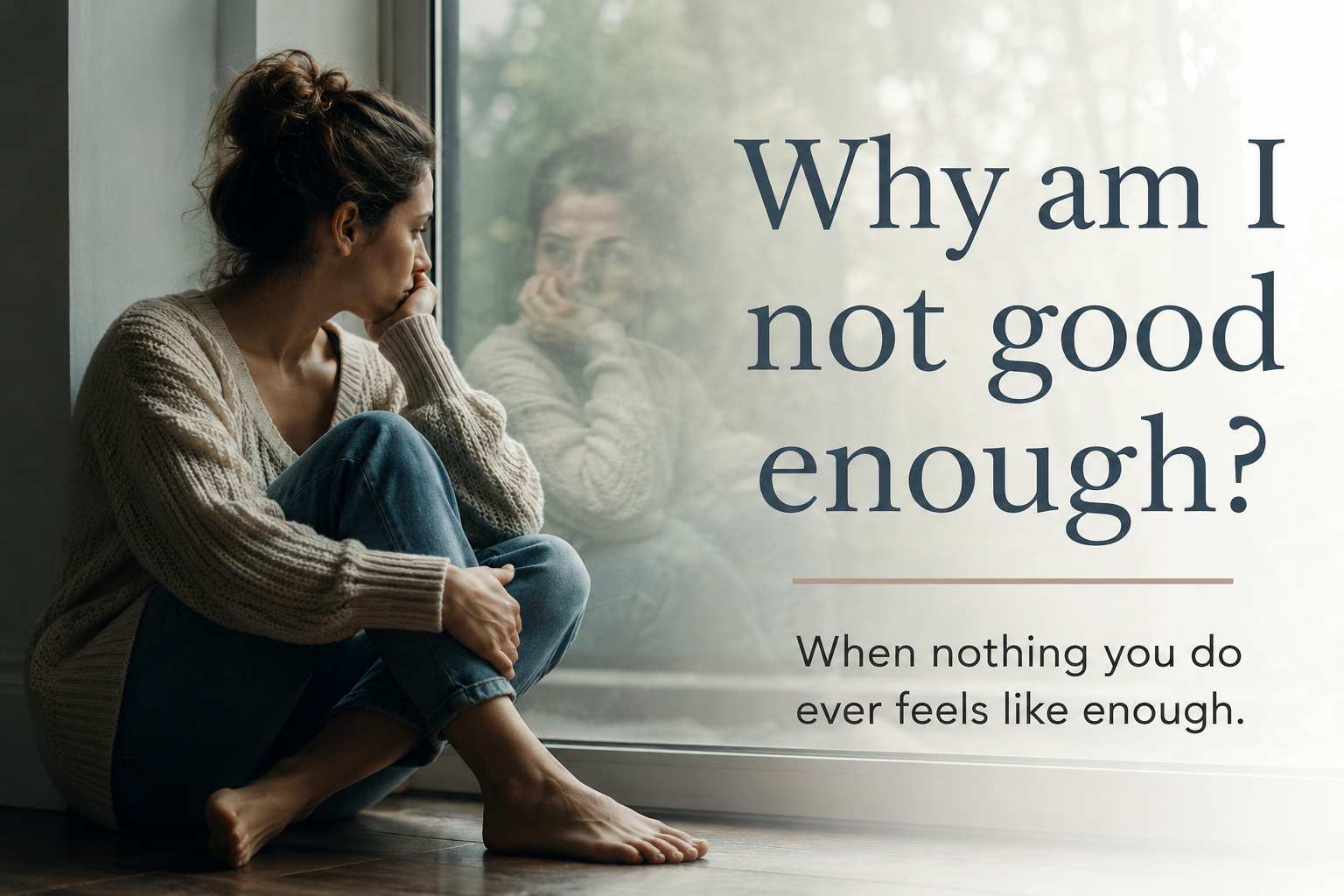
You accomplish something.
For a minute, it feels good.
Then your mind moves on.
You should have done it sooner.
Someone else did it better.
You got lucky.
It really wasn’t that big of a deal.
Or now that you’ve reached this goal, there’s another one waiting.
So you work harder.
Try to be better.
Do more.
Become more useful.
More successful.
More attractive.
More dependable.
More impressive.
And somehow...
“Good enough” keeps moving farther away.
Eventually you start wondering:
Why am I never good enough?
The interesting part is that the answer may have very little to do with how capable, successful, lovable, or valuable you actually are.
Because “I’m not good enough” isn’t always an accurate assessment of your life.
Sometimes it’s an old conclusion you’ve been measuring your life against ever since.
What Does “Not Good Enough” Actually Mean?
It can mean different things to different people.
For one person:
I’m not successful enough.
For another:
Or:
I’m not smart enough.
I’m not a good enough parent.
I’m not good enough for this relationship.
I’m not doing enough with my life.
I should be further ahead by now.
The details change.
But underneath all of them may be the same basic feeling:
Something about me falls short.
That’s much heavier than simply wanting to improve.
There’s nothing wrong with wanting to become better at something.
The problem starts when improvement becomes an attempt to finally earn the right to feel okay about yourself.
Where Does the Feeling of Not Being Good Enough Come From?
Sometimes the connection is obvious.
Maybe you grew up with constant criticism.
Maybe your grades were never high enough.
Maybe you were compared to a sibling.
Maybe affection or approval seemed tied to performance.
Maybe someone regularly pointed out your flaws.
But it doesn’t always require an obviously difficult childhood.
Sometimes the message is subtler.
Maybe one sibling got praised for being smart, athletic, attractive, responsible, or successful.
You quietly decided:
“That must mean I’m the other one.”
Maybe you struggled with something that seemed easy for everybody else.
Maybe you were rejected by someone whose opinion mattered enormously at the time.
Maybe you experienced a failure and attached meaning to it.
Not:
“I failed at this.”
but:
“Maybe I’m just not good enough.”
And once that meaning gets attached, later experiences can reinforce it.
You Don’t Need Someone Telling You You’re Not Good Enough Anymore
This is one of the strange things about beliefs.
Eventually they can become self-sustaining.
Maybe nobody in your current life is telling you that you aren’t enough.
You do it for them.
Someone compliments you.
You dismiss it.
Someone tells you that you did a good job.
You immediately think about what you could have done better.
Someone loves you.
You wonder why.
Someone offers you an opportunity.
You start looking for reasons you’re not qualified.
At some point the outside critic isn’t necessary anymore.
The belief has learned how to speak in your own voice.
Why Am I So Hard on Myself?
Because being hard on yourself can start to feel useful.
Maybe criticism was how you learned to improve.
So you start believing:
If I stop pushing myself, I’ll become lazy.
If I become satisfied, I’ll stop growing.
If I don’t point out my flaws, nobody will fix them.
That can create successful people.
It can also create successful people who never feel successful.
There’s a difference between:
“I can do better.”
and
“I’m not good enough until I do better.”
One encourages growth.
The other makes your worth conditional.
The Finish Line Keeps Moving
Suppose you believe getting in shape will finally make you feel confident.
You do it.
Then you notice somebody in better shape.
Maybe earning more money will fix it.
You make more.
Now someone else makes more than you.
Maybe finding a relationship will prove you’re lovable.
You find one.
Now you worry they’ll discover they could do better.
Maybe getting promoted will make you feel capable.
You get promoted.
Now you’re afraid everyone will realize you don’t belong there.
The problem isn’t necessarily the goal.
The problem is asking the goal to settle a question it was never capable of answering:
“Am I enough?”
Achievement can answer:
“Can I accomplish this?”
It cannot permanently answer:
“Am I worthy?”
“Not Good Enough” Can Shape Your Relationships
This belief can show up everywhere in relationships.
You tolerate things you normally wouldn’t.
You work too hard to keep someone interested.
You need constant reassurance.
You become jealous.
You compare yourself with an ex.
You assume distance means you’ve done something wrong.
You stay with someone who repeatedly hurts you because part of you wonders:
“What if this is the best I can get?”
Or you go in the opposite direction.
You push people away.
If someone gets too close, they may eventually see the parts of you that you’re afraid aren’t enough.
So distance feels safer.
Sometimes the person desperately wanting love and the person running from love are carrying versions of the same belief.
It Can Affect What You Accept From Other People
If someone believes they deserve more, they tend to notice when something repeatedly falls short of that standard.
If you already question your worth, your internal conversation can sound very different:
Maybe I’m expecting too much.
Maybe I should be more understanding.
Nobody’s perfect.
At least they’re here.
Maybe I’m the problem.
Compromise is part of every relationship.
But there’s a difference between compromise and continually lowering the standard because you don’t believe you’re entitled to ask for more.
“Not Good Enough” Can Keep You Small
Maybe there’s something you want.
A different career.
A business.
A promotion.
A relationship.
A creative project.
A completely different life.
You think about it.
Then the belief starts negotiating.
You don’t have enough experience.
Someone else would be better.
People will laugh at you.
You’re not ready.
Who do you think you are?
So you wait until you feel more qualified.
More confident.
More prepared.
More worthy.
And sometimes that day never comes.
Not because you couldn’t have done it.
Because you were waiting to feel good enough before allowing yourself to try.
Perfectionism Can Be a Way of Hiding the Belief
Perfectionism often looks like high standards.
Sometimes it is.
But sometimes perfectionism means:
“If this is perfect, nobody can criticize me.”
Or:
“If I do everything right, nobody can reject me.”
Or:
“If I achieve enough, I won’t have to feel inadequate.”
That’s exhausting.
Because perfection is an impossible standard.
So even your successes contain evidence that you could have done better.
At that point, perfectionism isn’t really about the work anymore.
It’s about trying to escape the feeling underneath it.
People-Pleasing Can Come From the Same Place
If you don’t completely believe your value is secure, being needed can become incredibly important.
So you become:
the dependable one.
the easygoing one.
the one who never complains.
the person everybody calls.
the person who fixes everything.
You say yes.
Even when you want to say no.
You avoid conflict.
You try to keep everybody happy.
And being useful starts feeling very close to being valuable.
The problem comes when you eventually realize:
Everyone knows what they need from me. I’m not sure I know what I need anymore.
Why Compliments Don’t Fix It
This is another clue that we may be dealing with something deeper than a current lack of confidence.
People tell you:
You’re doing great.
You’re talented.
You’re a good person.
You should be proud of yourself.
You hear them.
Maybe you even appreciate it.
But it doesn’t quite land.
Because information that conflicts with an established belief often gets explained away.
They’re just being nice.
They don’t really know me.
They have to say that.
If they knew everything, they’d feel differently.
Meanwhile, criticism gets accepted immediately.
Someone could compliment you nine times and criticize you once.
Guess which one you think about on the drive home?
Comparison Becomes Almost Impossible to Win
There will always be somebody:
younger.
wealthier.
better looking.
more successful.
more confident.
more educated.
more talented.
more popular.
If comparison is how you determine whether you’re enough, you’ve entered a competition with no finish line.
Even if you become better than 99% of people at something, your attention can find the remaining 1%.
And suddenly they become the standard.
That’s why “become better than everybody else” isn’t a workable solution to feeling inadequate.
Your mind can always find another everybody else.
Sometimes You’re Trying to Prove Something to Someone Who Isn’t Even There Anymore
This can happen without realizing it.
Maybe you’re still trying to prove something to:
a parent.
an ex.
a teacher.
a bully.
someone who rejected you.
someone who underestimated you.
Or maybe simply to the younger version of yourself who once felt overlooked.
You achieve something and somewhere underneath it is:
“See? I did amount to something.”
That can be powerful motivation.
But if your entire life becomes a courtroom where you’re constantly presenting evidence that you deserve to exist...
winning the case becomes nearly impossible.
Because you keep reopening it.
What If “Not Good Enough” Is an Old Story?
This is the question I find more useful than:
“How do I become good enough?”
What if you already are?
What if the problem is that part of you is still measuring yourself with a rule you learned years ago?
Maybe the rule was:
I have to perform to be valued.
I have to keep everyone happy to be loved.
Mistakes mean I’m defective.
Other people are more important than me.
I need to prove myself.
If somebody rejects me, it means something is wrong with me.
At one point those conclusions may have seemed completely logical.
That doesn’t mean they need to keep defining your life.
Conscious Understanding Doesn’t Always Change the Feeling
You may already know this intellectually.
You may be reading this thinking:
“Yes. I know I’m good enough.”
And still not feel it.
That isn’t unusual.
The conscious mind can understand something long before the automatic reactions underneath it change.
You can consciously believe:
“I deserve a healthy relationship.”
and still tolerate less.
You can consciously believe:
“I’m capable.”
and still avoid the opportunity.
You can consciously believe:
“Other people’s approval doesn’t determine my value.”
and still feel terrible when somebody is disappointed with you.
That gap between what you know and how you react is exactly where I become interested.
The Belief Can Become Part of Your Identity
After enough years, you may stop noticing it as a belief.
It just becomes:
“This is who I am.”
I’m insecure.
I’m bad with relationships.
I’m not ambitious.
I’m shy.
I’m a people pleaser.
I’m not leadership material.
I’m just somebody who worries.
I’m always the one who screws things up.
But personality is complicated.
Some of what we call personality may also include strategies we learned because they once helped us navigate life.
If you learned not to take risks, cautious may become part of your identity.
If you learned that keeping people happy prevented conflict, people-pleasing may feel like personality.
If you learned that being perfect brought approval, achievement may become how you measure your worth.
Understanding that creates an interesting possibility:
Maybe every part of who you’ve been isn’t necessarily who you have to remain.
What Would Change If You Didn’t Need to Prove You Were Enough?
This question is bigger than self-esteem.
Imagine choosing a relationship based on whether it is good for you rather than whether you can get the other person to choose you.
Imagine applying for something before you feel completely qualified.
Imagine saying no without spending the next three days feeling guilty.
Imagine being able to receive a compliment without arguing with it in your head.
Imagine making a mistake and correcting it instead of turning it into evidence about your worth.
Imagine accomplishing something and actually allowing yourself to experience it before deciding what comes next.
Imagine asking:
“What do I genuinely want?”
instead of:
“What would finally prove that I’m enough?”
Those two questions can produce very different lives.
You Don’t Need to Become Arrogant
People sometimes worry about this.
If I stop criticizing myself...
If I stop trying to prove myself...
If I decide I’m already enough...
Will I stop improving?
Probably not.
You can want to grow without believing your current self is defective.
You can become healthier because you value yourself.
You can build a business because you want one.
You can improve your relationships because they matter.
You can learn from failure because you want a different result.
Growth doesn’t require self-rejection.
This Is the Kind of Belief I Look Underneath
When someone repeatedly feels like they aren’t enough, I’m not interested in simply telling them:
“You’re amazing. Believe in yourself.”
They’ve probably heard versions of that before.
I want to understand what gives the belief its weight.
When does it show up?
What triggers it?
What happens when someone criticizes you?
What happens when somebody rejects you?
What happens when you succeed?
What happens when you fail?
Where do you keep trying to prove yourself?
From there, I may use Emotion Code, Body Code, and Belief Code work to explore things such as:
emotional experiences connected to inadequacy or rejection
subconscious beliefs around worth and belonging
criticism and comparison
approval-seeking
perfectionism
fear of failure
fear of success or visibility
beliefs about what you must do to deserve love, acceptance, or respect
The goal isn’t to convince you that you’re perfect.
Nobody is.
The goal is to stop requiring perfection before you’re allowed to believe you have value.
You May Not Need a Better Version of Yourself
Maybe the solution isn’t becoming:
more impressive.
more successful.
more attractive.
more productive.
more agreeable.
more useful.
Maybe the work is questioning why all of those things became requirements in the first place.
Because if the belief underneath everything remains:
“I’m not good enough,”
every achievement simply becomes another temporary attempt to disprove it.
Change the belief, and the same life can start looking very different.
Not because you suddenly stop wanting anything.
Because what you want no longer has to carry the responsibility of proving who you are.
Start With Where “Not Good Enough” Costs You the Most
You don’t need to solve your entire self-worth story at once.
Start with one place where it keeps affecting your life.
Maybe it’s relationships.
Work.
Perfectionism.
Fear of trying.
Constant comparison.
People-pleasing.
Difficulty setting boundaries.
Or feeling like no matter how much you accomplish, it never really counts.
Your $47 Discovery Session is a 30-minute working session where we start with one real issue and begin tracing what may be underneath the reaction.
You don’t need to know where the belief came from.
That’s part of what we explore.
If we find that it connects to a larger pattern and deeper work makes sense, we can talk about what that would look like.
But you don’t need to become a completely different person before you’re allowed to build a different life.
Sometimes the first change is simply questioning whether “I’m not good enough” was ever the truth in the first place.
