
Why Do I Keep Making the Same Mistakes?
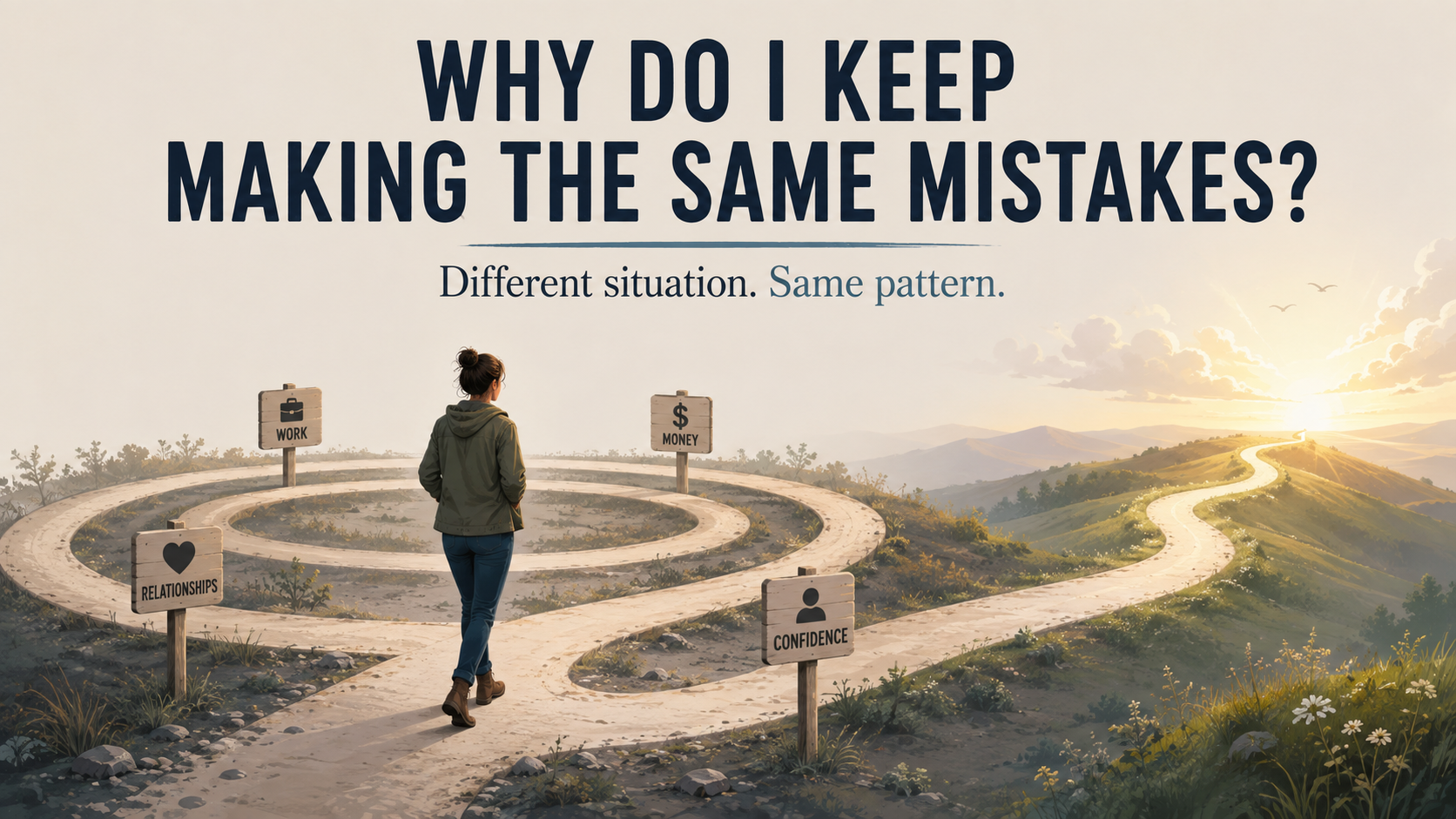
You knew better.
That may be the most frustrating part.
You saw what happened last time. You told yourself you weren’t going to do it again.
Maybe you even understood exactly why it went wrong.
And then somehow...
You chose the same kind of relationship.
You ignored the same warning signs.
You overreacted the same way.
You procrastinated until the opportunity disappeared.
You trusted someone you already had doubts about.
You shut down when things became uncomfortable.
You spent money you promised yourself you would save.
You said yes when you wanted to say no.
Different day. Different situation.
Same ending.
Eventually you start asking:
Why do I keep making the same mistakes when I already know better?
That’s a much better question than assuming you’re weak, stupid, undisciplined, or incapable of changing.
Because sometimes the problem isn’t that you didn’t learn the lesson.
Sometimes the problem is that understanding something consciously doesn’t automatically change the response underneath it.
Why Do I Keep Repeating the Same Mistakes?
Most of us assume that once we understand a problem, we should be able to stop doing it.
And sometimes we can.
Touch a hot stove once and you probably don’t need a twelve-week seminar to convince yourself not to do it again.
But emotional patterns are different.
You can know:
This relationship isn’t good for me.
and still feel drawn back to it.
You can know:
I don’t need to take this personally.
and still feel rejected.
You can know:
There’s nothing dangerous happening.
and still feel anxious.
You can know:
I should speak up.
and still freeze.
That’s because your conscious mind isn’t making every decision by itself.
Sometimes that shows up as self-sabotage, behavior that works against what you consciously want even when part of you knows better.
Your nervous system and subconscious are constantly interpreting what’s happening based partly on what they learned before.
And sometimes those older lessons are louder than what you consciously know today.
Knowing Better Doesn’t Always Mean Responding Differently
Imagine you grew up having to keep people happy to avoid conflict.
You may be 40 years old now and completely understand that you’re allowed to have boundaries.
You’ve read the books.
You’ve listened to the podcasts.
You know you shouldn’t say yes to everything.
Then someone becomes disappointed with you.
Suddenly your chest tightens.
You feel guilty.
You start explaining yourself.
And five minutes later you’ve agreed to something you didn’t want to do.
Your conscious mind knew better.
But another part of you recognized something familiar:
Someone is unhappy with me. I need to fix it.
That response may have been learned long before you ever had words for it.
Why Old Patterns Can Feel So Familiar
Human beings don’t automatically move toward what is healthiest.
We often move toward what feels familiar.
That distinction matters.
If chaos was normal growing up, calm can feel strange.
If rejection was common, you may expect rejection even when someone genuinely cares about you.
If you had to prove your worth, simply being accepted may feel uncomfortable.
If vulnerability once led to pain, keeping people at a distance can feel safer.
None of that means you consciously want the old situation.
It means your system learned what to expect.
And familiar can sometimes feel safer than unknown, even when the familiar thing keeps hurting you.
Repeating Relationship Patterns
Relationships are one of the easiest places to see this.
Someone says:
“Why do I always end up with the same kind of person?”
Different face.
Different name.
Different relationship.
Same basic dynamic.
Maybe they keep choosing emotionally unavailable people.
Maybe they become intensely attached and then panic when someone gets close.
Maybe they ignore warning signs early in the relationship.
Maybe they become suspicious when nothing is actually wrong.
Maybe they constantly need reassurance.
Maybe they keep becoming the rescuer.
At some point it’s worth asking a different question.
Instead of:
“Why are all my relationships like this?”
ask:
“What keeps feeling familiar to me in these relationships?”
That question can reveal a lot.
The Situation Changes. The Reaction Doesn’t.
Patterns aren’t always obvious because the circumstances can look completely different.
Maybe your issue isn’t repeatedly choosing the same relationship.
Maybe it’s what happens whenever you feel:
criticized
rejected
ignored
embarrassed
out of control
responsible for everyone
uncertain
abandoned
pressured
not good enough
The people and circumstances change.
But something touches the same emotional nerve.
And suddenly the old reaction appears again.
That’s why you can spend years thinking you have twenty unrelated problems when several of them may connect to the same underlying belief or learned response.
What Beliefs Sit Under Repeating Patterns?
Sometimes the belief underneath a pattern is pretty simple.
It might be:
I’m not good enough.
People always leave.
I can’t trust anyone.
I have to keep everyone happy.
If I fail, I’ll be humiliated.
If I let my guard down, something bad will happen.
I’m responsible for how everyone else feels.
I don’t deserve something better.
You may not consciously agree with any of those statements.
That’s important.
You can consciously believe:
“I deserve a healthy relationship.”
while still reacting as though:
“People eventually leave.”
Both can exist at the same time.
That’s one reason positive thinking alone doesn’t always change a deeply repeated pattern.
You’re trying to replace the thought without necessarily changing what created the reaction.
Breaking Patterns Starts With Finding the Pattern
Before you can change something, you need to know what keeps repeating.
Not just the obvious outcome.
Look at what happens right before it.
Ask yourself:
What usually triggers me?
What feeling shows up first?
What do I immediately assume the situation means?
What do I do next?
What happens because of that reaction?
For example:
Someone doesn’t reply to a text.
You feel uneasy.
The meaning becomes:
“They’re losing interest.”
You start overthinking.
You send another message.
Then another.
The other person feels pressured and pulls back.
Now your original fear appears to be confirmed.
“See? People always leave.”
That’s how patterns can reinforce themselves.
Breaking Unhealthy Patterns Isn’t About Blaming the Past
Looking at earlier experiences doesn’t mean blaming your childhood for everything that happens today.
Sometimes a bad decision is simply a bad decision.
Sometimes another person really is behaving badly.
Sometimes life is difficult because life is difficult.
But when the same type of reaction or outcome keeps appearing, it makes sense to ask whether something older is influencing what happens next.
The point isn’t to live in the past.
The point is to stop letting the past quietly shape the future.
What About Breaking Generational Patterns?
Sometimes a pattern didn’t begin with you.
Families pass down much more than eye color and last names.
Children learn:
how conflict is handled.
how love is expressed.
whether emotions are safe to show.
whether money feels secure or frightening.
whether success is encouraged or criticized.
whether boundaries are respected.
whether anger means danger.
whether people can be trusted.
Those lessons can become so normal that you don’t realize they’re lessons at all.
They simply feel like:
“This is how life works.”
Breaking a generational pattern can begin when you recognize:
“Maybe this is what I learned. It doesn’t have to be what I continue.”
So How Do I Stop Making the Same Mistakes?
More awareness is useful.
But if awareness were always enough, you probably wouldn’t still be reading this.
The deeper question is:
What keeps making the old response feel necessary?
What belief is attached to it?
What emotional experience helped create it?
What does your system think it is protecting you from?
Because the behavior that frustrates you today may have started as an attempt to protect you somewhere else.
Overthinking may have helped you anticipate problems.
People-pleasing may have helped you avoid conflict.
Shutting down may have helped you avoid getting hurt.
Keeping people at a distance may have protected you from rejection.
Staying hyper-independent may have prevented disappointment.
The problem is that a strategy can outlive the situation that created it.
And then protection becomes limitation.
This Is Where the Deeper Work Begins
This is the kind of work I use Emotion Code, Body Code, and Belief Code to explore.
We start with the issue happening now.
Not your entire life story.
Not every mistake you’ve ever made.
One real pattern.
Then we begin looking underneath it for things like:
emotional experiences still connected to the reaction
subconscious beliefs that may be influencing what happens next
learned nervous-system responses
associations that once felt protective
older meanings your system may still be using today
The goal isn’t to convince yourself to make better choices.
You already know you want something different.
The goal is to understand why the old choice, reaction, or situation keeps becoming familiar enough to repeat.
Because when what’s underneath changes, what happens next can begin to change too.
You Don’t Have to Keep Repeating the Same Story
Your past can explain a pattern without having to dictate your future.
And understanding why something happened isn’t the same as being stuck with it.
If you keep asking:
“Why do I keep making the same mistakes?”
there may be a better question:
“What keeps making this response feel like the one I’m supposed to choose?”
That’s where the pattern starts becoming understandable.
And once you can see what’s underneath it, you finally have something different to work with.
Start With One Pattern
If there’s something in your life that keeps repeating, we don’t need to solve your entire life in one conversation.
We start with one issue.
Your $47 Discovery Session is a 30-minute working session where we begin tracing what may be underneath the pattern you’re dealing with now.
If we find that the issue goes deeper and more work makes sense, we can talk about what that would look like.
But the first step is simply finding out what may be keeping the same story alive.
