
Why Am I Always in Fight or Flight Mode Even When Nothing Is Wrong?
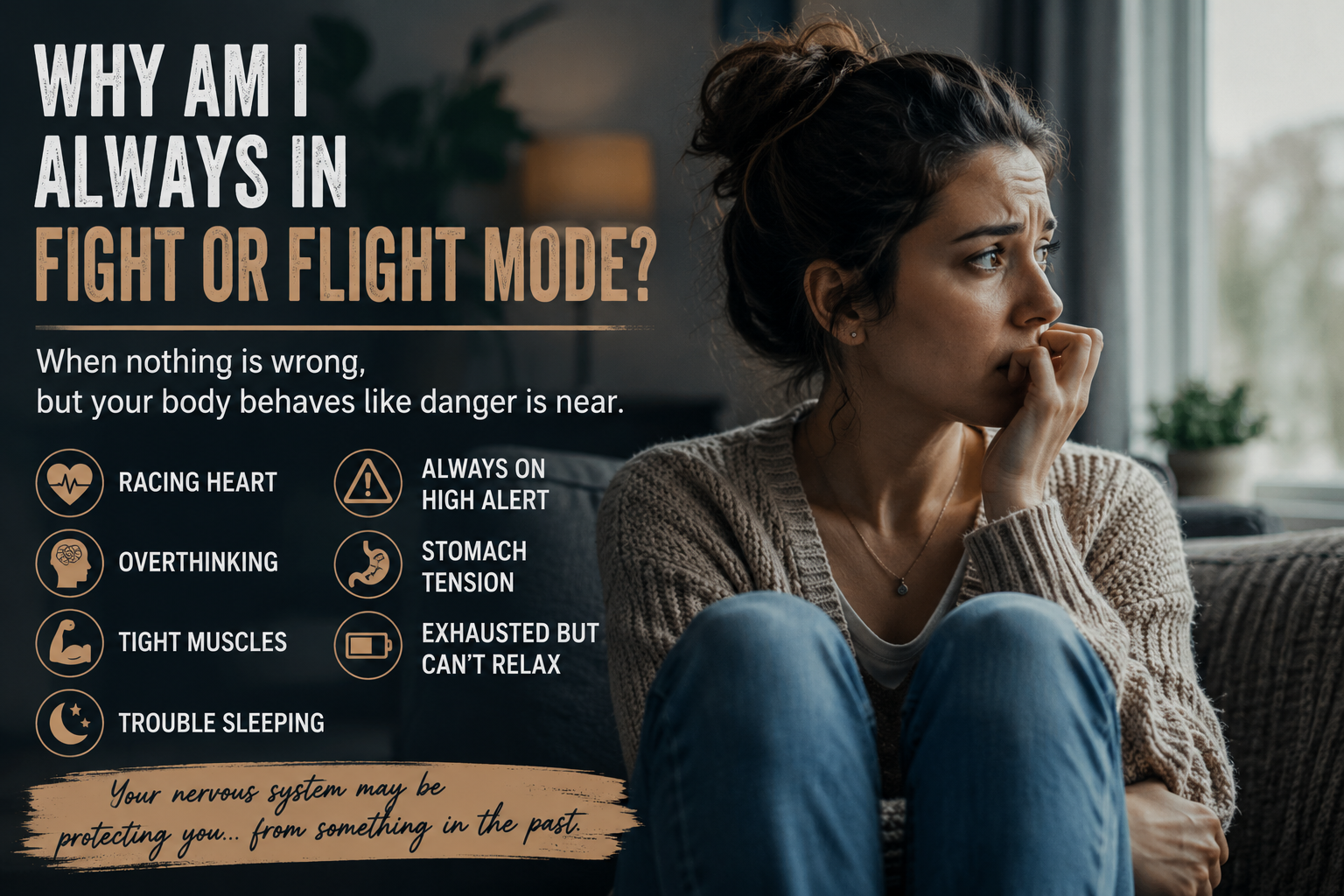
You’re sitting at home.
Nothing is happening.
There’s no emergency. No argument. No obvious threat.
And yet your body seems to disagree.
Your shoulders are tight. Your jaw is clenched. Your heart may be beating harder than it should. You can’t completely relax. Your mind keeps scanning, thinking, preparing.
Sometimes you don’t even know what you’re preparing for.
You just know you can’t seem to shut it off.
Eventually you start wondering:
Why am I always in fight or flight mode when nothing is actually wrong?
The answer may not be that your body is malfunctioning.
Sometimes your system has simply become very good at protecting you.
The problem is that it may still be responding to rules it learned when protection really was necessary.
What Is Fight or Flight?
Fight or flight is part of your body’s normal survival response.
If something genuinely threatens you, you don’t want to spend ten minutes calmly analyzing your options.
Your system needs to react.
Your heart rate can increase. Muscles tighten. Attention narrows. Energy becomes available. Your body prepares to fight the threat, escape it, freeze, or otherwise protect you.
That response is useful when the danger is real.
The problem is when your system keeps sounding the alarm after the emergency is gone or in situations that aren’t actually dangerous.
Then normal life can start feeling strangely exhausting.
Why Does My Body Feel Stressed When I’m Not Stressed?
Because your conscious mind is not the only thing evaluating what’s happening around you.
You can look around and logically know:
“I’m fine.”
But your nervous system is also paying attention to patterns.
Tone of voice.
Facial expressions.
Conflict.
Uncertainty.
Rejection.
Being watched.
Feeling trapped.
Not knowing what someone is going to do.
Losing control.
Sometimes something happening now resembles an earlier experience just enough for your system to react.
Not because the two situations are identical.
Because something about them feels familiar.
Your conscious mind may see Tuesday afternoon.
Your body may recognize a pattern it learned years ago.
The Reaction Can Happen Before the Explanation
This is one of the things that confuses people most.
You feel it first.
The tight chest.
The stomach drop.
The tension.
The irritability.
The urge to leave.
The feeling that something is wrong.
Then your mind tries to explain it.
What am I worried about?
Why do I feel like this?
Did something happen?
What am I forgetting?
Sometimes the thought didn’t create the reaction.
The thought showed up because your brain was trying to explain a reaction that had already started.
That’s a very different way of looking at anxiety and stress responses.
Your Nervous System Learns From Experience
Imagine growing up where you never quite knew what version of someone you were going to get.
Maybe things were calm one minute and explosive the next.
Maybe criticism came unexpectedly.
Maybe you had to pay close attention to somebody’s mood.
Maybe conflict meant you needed to stay quiet.
Maybe making mistakes had consequences that felt much bigger than the mistake itself.
You can get very good at noticing tiny changes.
A look.
A sigh.
A tone.
A door closing harder than usual.
That sensitivity may have been useful.
You learned:
Pay attention.
Don’t relax too much.
Something could happen.
Then you grow up.
The environment changes.
But the system that learned those rules doesn’t necessarily receive a memo saying:
“We don’t live there anymore.”
Sometimes Hypervigilance Looks Like Personality
After enough years, being on guard can simply feel like who you are.
You might describe yourself as:
an overthinker.
a worrier.
someone who can’t sit still.
a control freak.
someone who notices everything.
someone who always expects the worst.
But sometimes what looks like personality also contains learned protection.
You may not naturally be incapable of relaxing.
You may have become very good at staying ready.
There’s a difference.
Why Can’t My Body Relax?
For some people, relaxation itself feels uncomfortable.
That sounds backwards until you think about it.
If vigilance once helped keep you safe, lowering your guard can feel risky.
So you finally get a quiet afternoon.
Nothing needs your attention.
And within ten minutes...
you’re checking your phone.
thinking about work.
finding something to clean.
remembering something you forgot.
planning tomorrow.
wondering whether someone is upset with you.
Your mind finds another problem.
Not necessarily because you enjoy stress.
Because being alert may feel more familiar than doing nothing.
Sometimes peace takes getting used to.
You May Be Waiting for the Other Shoe to Drop
Things are going well.
Instead of enjoying them, you become suspicious.
This can’t last.
The relationship is good.
When are they going to change?
Work is going well.
Something is going to go wrong.
Your health is good.
What am I missing?
You finally have money saved.
Watch, something expensive is going to happen now.
This can make a good life surprisingly difficult to enjoy.
The problem is no longer just dealing with bad things when they happen.
You’re experiencing them before they happen.
And sometimes they never happen at all.
Control Can Become a Way to Feel Safe
If uncertainty activates your system, control can feel like the solution.
You plan everything.
Think through every possibility.
Double-check.
Prepare for what could go wrong.
Try to manage other people’s reactions.
Replay conversations.
Predict outcomes.
There’s nothing wrong with being prepared.
But preparation has no natural stopping point when the goal is to eliminate uncertainty.
There will always be another possibility you haven’t considered.
Eventually control can become an impossible job:
Make sure nothing unexpected ever happens.
No human being can do that.
Fight or Flight Doesn’t Always Look Like Panic
This is important.
Living in a protective state doesn’t necessarily mean visibly panicking.
Sometimes it looks like:
irritability.
being easily startled.
difficulty sleeping.
constant mental activity.
needing everything done a certain way.
being unable to sit still.
shutting down during conflict.
avoiding difficult conversations.
getting defensive very quickly.
feeling exhausted even when you haven’t done much physically.
needing to know what everyone around you is thinking.
Sometimes the person who says:
“I’m not anxious. I’m just always pissed off.”
may still be dealing with a system that rarely feels completely safe.
Anger Can Be Part of Protection Too
Fight is right there in the name.
Sometimes when people feel threatened, vulnerable, criticized, ignored, embarrassed, controlled, or rejected, the protective response is anger.
That doesn’t excuse harmful behavior.
But understanding the reaction gives you something more useful to work with than:
“I just need to stop getting angry.”
The deeper question becomes:
What does my system think is happening in that moment?
A comment that seems small to someone else may carry much more meaning for you.
Not because you’re irrational.
Because it may be touching something older.
Why Does My Reaction Feel Bigger Than the Situation?
This is one of the biggest clues that the present moment may not be the whole story.
Someone doesn’t text back.
Your reaction feels like abandonment.
Your boss gives minor feedback.
It feels like you’re about to lose your job.
Your partner asks a question.
It feels like criticism.
Someone disagrees with you.
It feels like rejection.
The present situation might account for part of the reaction.
But when the emotional intensity consistently seems larger than what is actually happening, I start becoming curious about what else the situation may represent.
Sometimes the moment is pressing an old button.
Your Body Can Learn Emotional Associations
The nervous system doesn’t need a philosophical explanation.
It learns through experience.
If a certain type of situation repeatedly led to pain, conflict, embarrassment, rejection, or fear, your system can begin preparing before the outcome is known.
That’s useful when the pattern accurately predicts danger.
Less useful when the pattern becomes:
Anyone who raises their voice is dangerous.
Any criticism means rejection.
Any uncertainty means something bad is coming.
Any conflict means the relationship is falling apart.
Any mistake means I’m in trouble.
Those reactions can continue even when your adult life is very different from the environment where they were learned.
Conscious Reassurance May Not Be Enough
This can be incredibly frustrating.
You tell yourself:
“There’s nothing wrong.”
Your body stays tense.
“I’m safe.”
Still tense.
“Stop worrying.”
Now you’re worried about the fact that you’re worried.
Very productive.
The problem is that conscious reassurance and automatic learned response are not always operating at the same level.
You can logically understand that something is safe while still having a physical or emotional reaction that says otherwise.
That gap is important.
It means the answer may not simply be thinking harder about why you shouldn’t feel this way.
Why Positive Thinking Sometimes Falls Short
Positive thinking can be useful.
Breathing exercises can be useful.
Meditation can be useful.
Exercise can be useful.
Good sleep, nutrition, boundaries, and stress management can all matter.
But if your system has attached meaning to certain situations, managing the reaction may not completely change what keeps activating it.
That’s why somebody can know ten different ways to calm themselves down and still keep getting activated by the same things.
Sometimes coping helps you deal with the alarm.
Deeper work asks:
Why does this particular situation keep setting off the alarm in the first place?
Those are different questions.
The Problem Can Spread Into Your Relationships
If your system is constantly watching for danger, relationships can become exhausting.
You may read into texts.
Notice changes in tone.
Assume distance means something is wrong.
Become defensive before someone finishes talking.
Need reassurance.
Withdraw.
Pick fights.
Try to control the outcome.
Or become extremely good at keeping everyone else happy so nothing gets uncomfortable.
From the outside, these behaviors can look unrelated.
Underneath, several may be doing the same job:
Trying to prevent something painful from happening.
It Can Affect the Life You Build
This is where constant fight or flight becomes bigger than feeling tense.
If unfamiliarity feels dangerous, you may avoid change.
If failure feels dangerous, you may avoid opportunity.
If rejection feels dangerous, you may stay quiet.
If conflict feels dangerous, you may become a people-pleaser.
If losing control feels dangerous, you may overthink every decision.
If vulnerability feels dangerous, you may push people away.
Then protection begins shaping your future.
Not because you consciously chose a smaller life.
Because avoiding certain feelings quietly began determining what you were willing to risk.
Your System May Be Protecting an Older Version of You
This is one of the ways I think about it.
Maybe the response made perfect sense once.
Maybe you genuinely needed to stay alert.
Maybe keeping someone happy reduced conflict.
Maybe shutting down kept things from getting worse.
Maybe expecting disappointment made disappointment easier to handle.
Maybe never fully relaxing helped you feel prepared.
Those responses deserve some respect.
They may have gotten you through something.
The problem is when yesterday’s protection becomes today’s limitation.
You’re no longer trying to survive the old situation.
But some part of you may still be acting as though you are.
What Beliefs Can Sit Underneath Constant Fight or Flight?
Every person is different, but beliefs underneath protective reactions can sometimes sound like:
I’m not safe.
Something bad is going to happen.
I have to stay in control.
I can’t trust people.
I have to be prepared.
People will hurt me if I let my guard down.
I’m responsible for keeping everything together.
I can’t make mistakes.
I have to keep everyone happy.
You may consciously disagree with every one of those statements.
That doesn’t necessarily mean your automatic reactions have caught up.
This Is the Kind of Pattern I Look Underneath
When someone tells me:
“I know nothing is wrong, but I still can’t relax,”
I’m interested in that contradiction.
We start with what is actually happening now.
What sets the reaction off?
What does the body do?
What emotion appears?
What thoughts immediately follow?
What does the situation seem to mean?
From there, I may use Emotion Code, Body Code, and Belief Code work to explore things such as emotional experiences connected to threat or uncertainty, subconscious beliefs around safety, learned responses to conflict or rejection, old associations involving control and predictability, and patterns that may still be influencing how the nervous system responds today.
The goal isn’t to convince yourself that nothing bad will ever happen.
Nobody gets that guarantee.
The goal is to help your present reactions become more connected to what is actually happening now, rather than what your system once learned to expect.
Physical Symptoms Still Deserve Medical Attention
One thing matters here.
Symptoms such as chest pain, heart palpitations, shortness of breath, persistent pain, dizziness, severe sleep problems, or other physical changes can have medical causes and should be appropriately evaluated.
Emotional or nervous-system patterns are not an explanation for every physical symptom.
You don’t have to choose between taking your physical health seriously and being curious about how stress and learned responses may also be affecting you.
Both can matter.
What Would Life Feel Like If You Didn’t Have to Stay Ready?
Imagine sitting quietly without your mind immediately looking for something to solve.
Imagine someone changing their tone without your body assuming the worst.
Imagine receiving criticism without feeling like you’re under attack.
Imagine uncertainty without immediately needing to control the outcome.
Imagine a good period in your life without waiting for something to ruin it.
Imagine being able to rest without feeling guilty, restless, or exposed.
That isn’t a small outcome.
Because when your system no longer has to spend so much energy protecting you from what might happen, that energy becomes available for what you actually want to build.
Start With What Keeps Setting Off the Alarm
You don’t need to figure out your entire nervous system.
Start with one situation where the reaction doesn’t seem to match the moment.
Maybe it’s criticism.
Conflict.
Rejection.
Uncertainty.
Being alone.
Someone pulling away.
Making a mistake.
Trying something new.
Or simply realizing that even when life is quiet, your body never seems to believe it.
Your $47 Discovery Session is a 30-minute working session where we start with one real issue and begin tracing what may be underneath that reaction.
You don’t need to know where it started.
That’s part of what we explore.
If we find that it connects to a larger pattern and deeper work makes sense, we can talk about what that would look like.
The goal isn’t to become a person who never feels stress.
Stress is part of being alive.
The goal is to stop living as though an emergency is happening when the emergency is already over.
