The Story Didn't Start With You
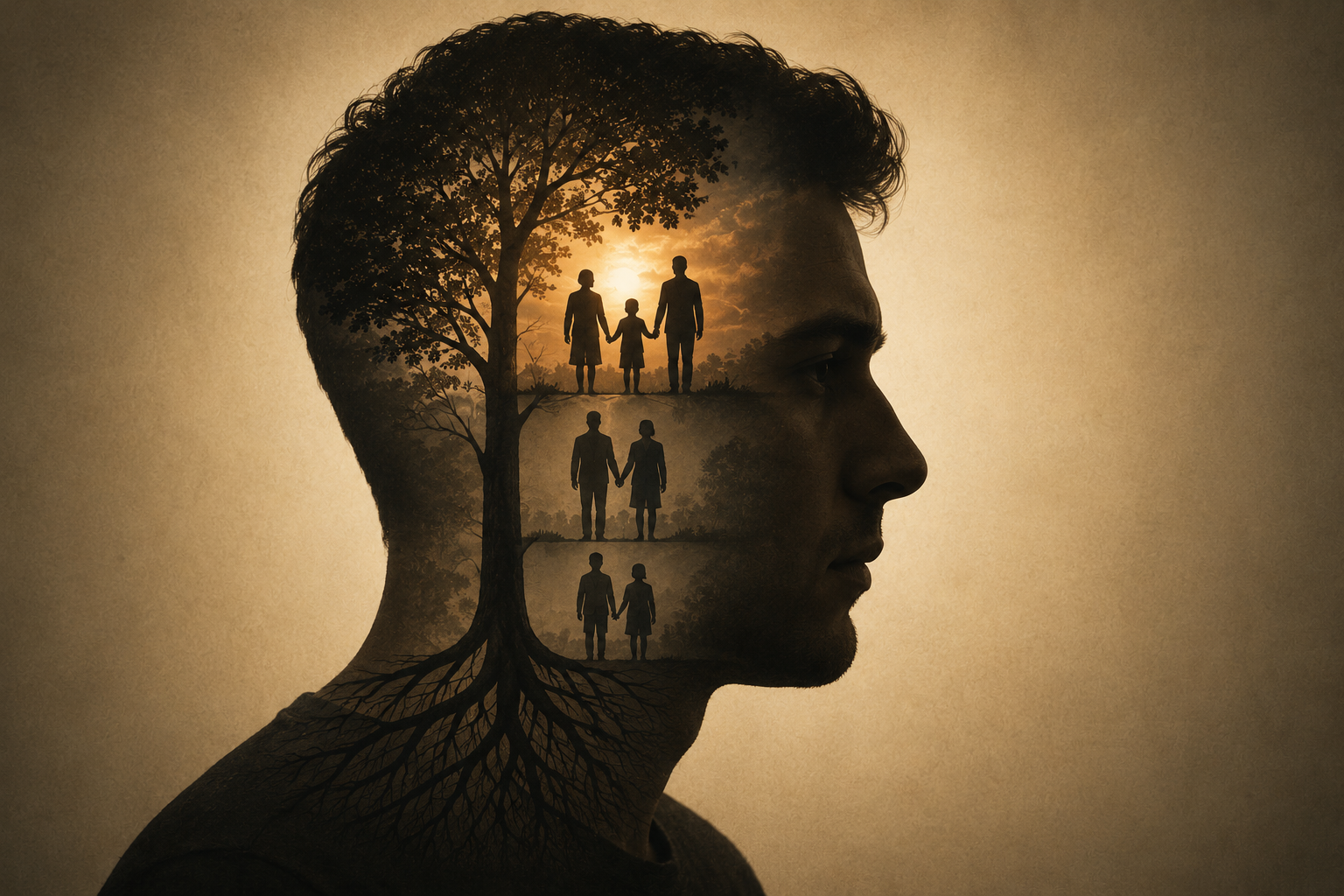
Profile of a man with family figures and branching roots inside his head, illustrating how family history, childhood experiences, and inherited influences can shape identity and emotional patterns.
What if some of the beliefs shaping your life today began long before you were born?
We've all heard the saying:
"The apple doesn't fall far from the tree."
Usually, we say it when a child looks like a parent.
Acts like them.
Talks like them.
Or catches themselves thinking...
"I'm becoming my father."
"I sound just like my mother."
But what if the resemblance goes deeper than appearance, habits, or personality?
What if families don't just pass down physical traits?
What if they also pass down stories?
Every Family Passes Something Down
When people think about inheritance, they usually think about eye color.
Height.
Hair color.
Maybe a crooked smile or a familiar laugh.
But families pass down far more than genetics.
They pass down ways of seeing the world.
How conflict is handled.
Whether emotions are expressed or hidden.
Whether love feels freely given or has to be earned.
How money is viewed.
Whether asking for help feels safe.
Whether mistakes are accepted or criticized.
Some of these lessons are spoken directly.
Many are never said aloud.
They are simply lived.
Children don't just inherit a home.
They inherit an emotional environment.
Long before they have the ability to question what they're experiencing, they're learning what feels safe, what feels dangerous, and who they believe they need to become to belong.
Some Patterns Are Learned
A child growing up around constant worry may learn that the world is unsafe.
A child surrounded by criticism may decide that mistakes are dangerous.
A child who receives attention only when achieving may begin to believe their value depends on what they accomplish.
These beliefs aren't inherited biologically.
They are absorbed.
Modeled.
Reinforced through experience.
Over time, they stop feeling like beliefs.
They begin to feel like reality.
But What If It Goes Even Deeper?
Over the years, I've worked with hundreds of people looking for answers to repeating patterns in their lives.
Some struggle with anxiety.
Some feel a constant need to prove themselves.
Some carry an intense fear of rejection.
Others repeat the same relationship patterns, even when they consciously want something different.
Many of the emotions and beliefs we uncover can be connected to the person's own experiences.
Childhood.
Relationships.
Loss.
Fear.
Moments that shaped how they learned to protect themselves and move through the world.
That makes sense.
But every so often...
something else appears.
An inherited emotional pattern.
An inherited belief.
When I use the phrase inherited belief, I'm not suggesting someone inherits a fully formed thought or memory.
I'm describing a recurring pattern I sometimes find in sessions—one that appears to have been carried through generations and later expressed through the person's own life experiences.
I don't see inherited emotions or beliefs nearly as often as the ones people develop through their own experiences.
But I find them often enough that I don't believe they should be ignored.
They rarely appear to be the entire story.
More often, they seem to become the starting point that a person's own experiences later build upon.
What is inherited may create the sensitivity. What happens in your own life gives that sensitivity a personal story.
The Science Is Asking Similar Questions
Researchers studying epigenetics are exploring whether severe stress and adversity can influence later generations through changes in how genes are expressed, without changing the underlying DNA sequence.
Some of the strongest evidence so far has come from animal research.
In one widely discussed study, researchers conditioned male mice to associate a specific scent with a mild shock. Their offspring—and even the following generation—showed a heightened sensitivity to that same scent despite never experiencing the conditioning themselves.
The mice didn't inherit the memory.
But they appeared to inherit a sensitivity.
Human beings, of course, are far more complex.
Researchers have to account for pregnancy, upbringing, family behavior, culture, and the emotional environment children grow up in. Because of that, the science in humans is still developing, and scientists continue to study how much stress-related sensitivity may be passed from one generation to the next.
Science has not demonstrated that specific beliefs themselves are inherited.
However, the growing research into epigenetics, combined with what we know about family systems and the emotional environments children grow up in, raises an interesting question.
Could some people begin life carrying sensitivities shaped, at least in part, by experiences that happened before they were born?
Whether those patterns are passed through biology, behavior, environment, or some combination of all three, many people recognize the result.
The same anxiety.
The same emotional distance.
The same perfectionism.
The same fear of rejection.
The same financial struggles.
The same addiction.
The same silence.
The same need to prove yourself.
Different people.
Different generations.
Remarkably similar stories.
When Family Traits Become Identity
Maybe "the apple doesn't fall far from the tree" means more than we thought.
Maybe the apple doesn't fall far from the tree because a child grows inside an emotional world that already exists.
They absorb the same fears.
Watch the same coping strategies.
Learn the same rules.
And perhaps, in some cases, begin life with sensitivities connected to what earlier generations endured.
We often call these things family traits.
"The women in our family are all worriers."
"The men in our family don't talk about their feelings."
"Everyone in our family struggles with money."
"We're just stubborn people."
"That temper runs in the family."
We laugh about them.
Accept them.
Treat them as personality.
But how often do we stop and ask...
Where did this story actually begin?
Maybe "the apple doesn't fall far from the tree" isn't simply about becoming your parents.
Maybe it's also about carrying stories no one realized they were passing down.
Inherited Patterns Don't Stand Alone
An inherited belief or sensitivity does not write your entire story.
Your own life still matters.
Your experiences shape you.
They reinforce certain fears and challenge others.
They help create the beliefs you eventually live from.
Someone who begins life with a heightened sensitivity to rejection may experience criticism and interpret it more deeply than someone else would.
A personal belief begins to form.
"I'm not accepted."
Later experiences reinforce it.
The belief grows stronger.
Eventually, it influences relationships.
Work.
Choices.
And how that person sees themselves.
By adulthood, it no longer feels like a belief.
It feels like personality.
It feels like...
"This is just who I am."
The inherited pattern may not have written the whole story.
But it may have helped write the opening chapter.
Life added the rest.
This Isn't About Blame
Whenever we talk about parents, grandparents, and family patterns, it's easy to fall into blame.
That isn't the point.
Your parents were likely shaped by stories they didn't consciously choose either.
So were your grandparents.
And the generations before them.
Most people aren't intentionally passing pain forward.
They're repeating what was familiar.
What helped them survive.
What they believed was normal.
What no one ever taught them to question.
Every family has stories it tells.
But every family also has stories it lives.
When a Story Starts Feeling Like Identity
Many of the traits we call personality may actually be adaptations.
Ways of behaving that developed around fear.
Rejection.
Pressure.
Comparison.
And the need to belong.
The possibility of inherited influences adds another layer to that idea.
Some of the beliefs shaping you were formed through your own experiences.
Some were learned by watching the people around you.
Some were built into the emotional environment of your family.
Some, in my experience, may have been carried forward from generations before you.
By the time those influences become part of your daily life, they no longer feel inherited.
They no longer feel learned.
They simply feel like...
you.
That may be why so many people spend years trying to fix their personality...
when what they're actually living from is a story.
The most important question may not be:
"What is wrong with me?"
It may be:
"Where did this story begin?"
The Good News
Whether a belief formed when you were five years old...
Whether it was absorbed from your family...
Or whether part of it reaches back through generations before you...
It does not have to define the rest of your life.
The goal isn't to prove that every story was inherited.
The goal is to recognize that every story can be rewritten.
You may not have written the first chapter.
But you are not required to keep repeating it.
A belief doesn't have to begin with you...
for it to end with you.